
CSF cytokine profiling should begin with a low-volume allocation plan and a CSF-specific feasibility question. Cerebrospinal fluid is not simply low-volume plasma: its expected cytokine concentrations, background, collection route, potential blood contribution, and storage history can determine whether a broad multiplex panel, a focused panel, or a higher-sensitivity approach will produce interpretable research data.
The most common avoidable loss is spending scarce CSF on a broad panel before confirming that the decision-critical analytes fall within a useful range. A fit-for-purpose plan starts with the biological question, available volume per sample, necessary replicates, and the minimum information the study needs to preserve for follow-up work.
Key takeaways
- Allocate limited CSF to the decision-critical endpoints before expanding to exploratory analytes.
- Evaluate CSF as its own matrix; do not transfer plasma assumptions about dilution, background, or detectable range.
- Select the platform by sample volume, target concentration range, panel breadth, and confirmation needs.
- Record handling, storage, visible blood contribution, and aliquot history because they shape CSF cytokine comparability.
Why CSF Cytokine Profiling Requires a Low-Volume Study Design
CSF volume is often finite and may need to support several research assays. Every aliquot decision therefore has an opportunity cost. A broad discovery panel can be valuable when many mediators are plausible and sufficient material is available. A focused high-sensitivity measurement may be more useful when only a few cytokines drive the hypothesis or when expected values are near the lower reporting range.
Start by ranking analytes into three tiers: decision-critical targets that determine the study conclusion, supportive pathway markers that provide context, and exploratory markers that are useful only if volume permits. This hierarchy gives the allocation plan a scientific rationale and avoids treating every panel analyte as equally valuable.
| Allocation question | Why it should be answered first | Design response |
|---|---|---|
| Available CSF volume per sample | Determines whether duplicates, re-runs, or confirmation are realistic. | Reserve material for primary readouts before exploratory expansion. |
| Expected concentration range | Determines whether breadth or analytical sensitivity is limiting. | Use a CSF-relevant pilot for critical targets. |
| Number of study groups and timepoints | Determines total material demand and batch structure. | Create a sample-volume ledger before analysis. |
| Need for orthogonal follow-up | Affects how much material must remain unspent. | Pre-allocate a retained aliquot when follow-up is central. |
For limited-volume projects, high-sensitivity cytokine protein assays may be appropriate when the priority is a small set of low-abundance targets. For broader pathway coverage, Luminex cytokine detection can be considered when the available volume and expected concentration range support multiplexing. The correct decision follows the study’s limiting factor, not a generic platform hierarchy.
CSF Cytokine Panel Selection: Breadth, Sensitivity, and Sample Allocation
Panel selection is a trade-off among analyte breadth, per-sample volume, expected concentrations, dynamic range, and the need for confirmation. A broad panel can identify coordinated patterns that a focused assay would miss. A focused panel can concentrate volume and analytical sensitivity on the markers that determine the study decision. Both are valid when matched to the question.
| Study need | Analytical direction | Key feasibility check |
|---|---|---|
| Exploratory pathway mapping | Broad multiplex panel with a ranked target list. | Are the decision-critical targets detectable in representative CSF? |
| Few low-abundance targets | Focused high-sensitivity assay or small targeted panel. | Does the planned volume support replicates and range coverage? |
| Known high and low targets together | Split strategy or complementary assays. | Will one dilution compromise either target group? |
| Multi-cohort comparison | Stable panel and standardized CSF handling with bridge controls. | Are matrix and storage histories comparable across cohorts? |
Platform descriptions alone do not predict performance in a specific CSF cohort. In a comparison of multiplex platforms using plasma, lower calibration limits did not translate uniformly into better detection in experimental samples for every analyte (Breen et al., 2020). The relevant lesson for CSF is that a targeted feasibility assessment should test the actual matrix and decision-critical targets, rather than assuming a catalogue sensitivity number resolves study risk.
If the study needs a discovery view and a focused endpoint, plan the two-stage allocation at the beginning. Reserve enough material for the focused stage rather than consuming all CSF in discovery. If the study has only enough material for one analytical route, select the platform that best protects the primary biological claim.
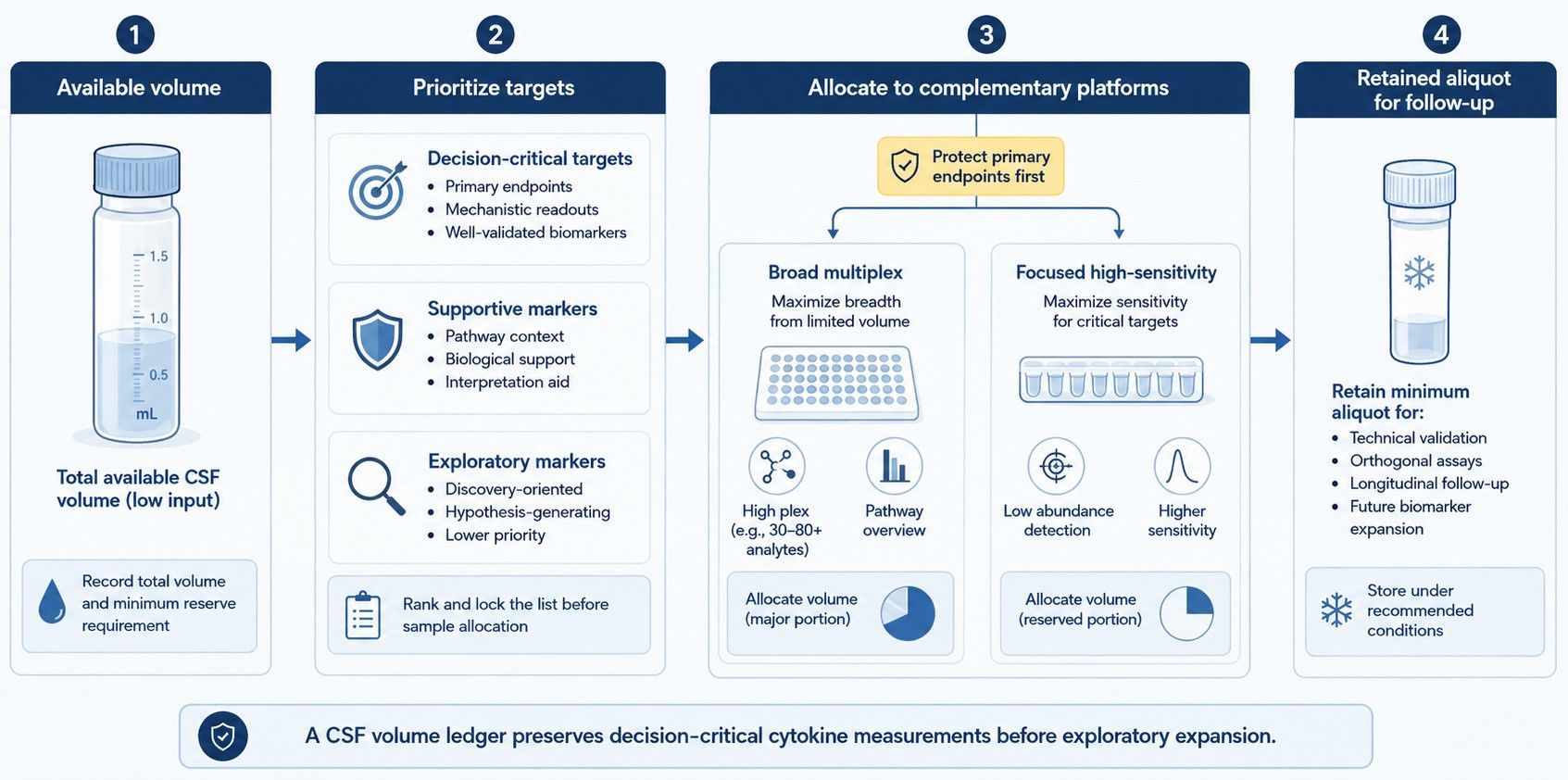 A CSF allocation plan protects decision-critical cytokines before exploratory testing uses limited volume.
CSF Matrix Controls and Pre-Analytical Handling
CSF should be qualified and reported as its own matrix. Potential blood contribution, collection-to-processing delay, temperature history, centrifugation or clarification approach, aliquoting, storage, and freeze–thaw history can affect the interpretation of low-abundance cytokines. These fields belong in the sample manifest, not only in laboratory notes.
Pre-analytical stability is analyte-specific. In one CSF study, measured effects of storage delay and temperature differed among analytes, while another study reported reduced concentrations for selected cytokines after extended room-temperature storage (Møller et al., 2021; Tan et al., 2022). This is why a broad statement that “CSF cytokines are stable” or “freeze–thaw is always harmful” is not defensible without reference to the specific targets and handling route.
A CSF feasibility set should address
- Detection of the decision-critical cytokines in representative CSF samples.
- Whether planned dilution preserves usable signal for both low- and high-abundance targets.
- Matrix-relevant blank, recovery, or dilution checks when the assay is not established for the intended CSF type.
- Whether sample-quality observations or potential blood contribution require a predefined stratification rule.
- How raw concentration, result qualifiers, sample history, and any excluded or limited samples will be retained in the final report.
Visible blood contribution or unusual appearance should be recorded rather than ignored. Whether it requires exclusion, separate analysis, or an interpretation note depends on the study’s research question and predefined criteria. The essential point is that the same rule should apply to every sample, not only to samples that change the apparent result.
For nonstandard matrices and feasibility work, the matrix qualification guide for multiplex cytokine assays provides the broader qualification framework. This article focuses specifically on the volume, sensitivity, and handling constraints that are especially important for CSF.
When to Use a Broad Multiplex Panel, a Focused Panel, or High-Sensitivity Detection
Use a broad multiplex panel when several cytokine pathways are plausibly relevant, the sample volume supports the planned assay, and the expected concentration range is compatible with the panel for the primary targets. Use a focused panel when a shorter list of mediators determines the hypothesis and the study benefits from concentrating sample use and analytical attention on those endpoints.
Use a high-sensitivity approach when expected target concentrations are likely to be near the lower reporting range and a small number of analytes carry the main decision. This is especially relevant when a broad panel would use scarce volume without providing reliable coverage of the targets that matter most. Do not frame sensitivity as universally better; the useful choice is the one that yields interpretable values for the actual CSF question.
If the question is exploratory and volume is adequate, choose broad multiplexing with a CSF feasibility step. If the question is driven by a few low-abundance cytokines, choose focused high-sensitivity detection. If the study requires both, reserve volume for a staged design and predefine which measurements are confirmatory rather than spending all material on the first panel.
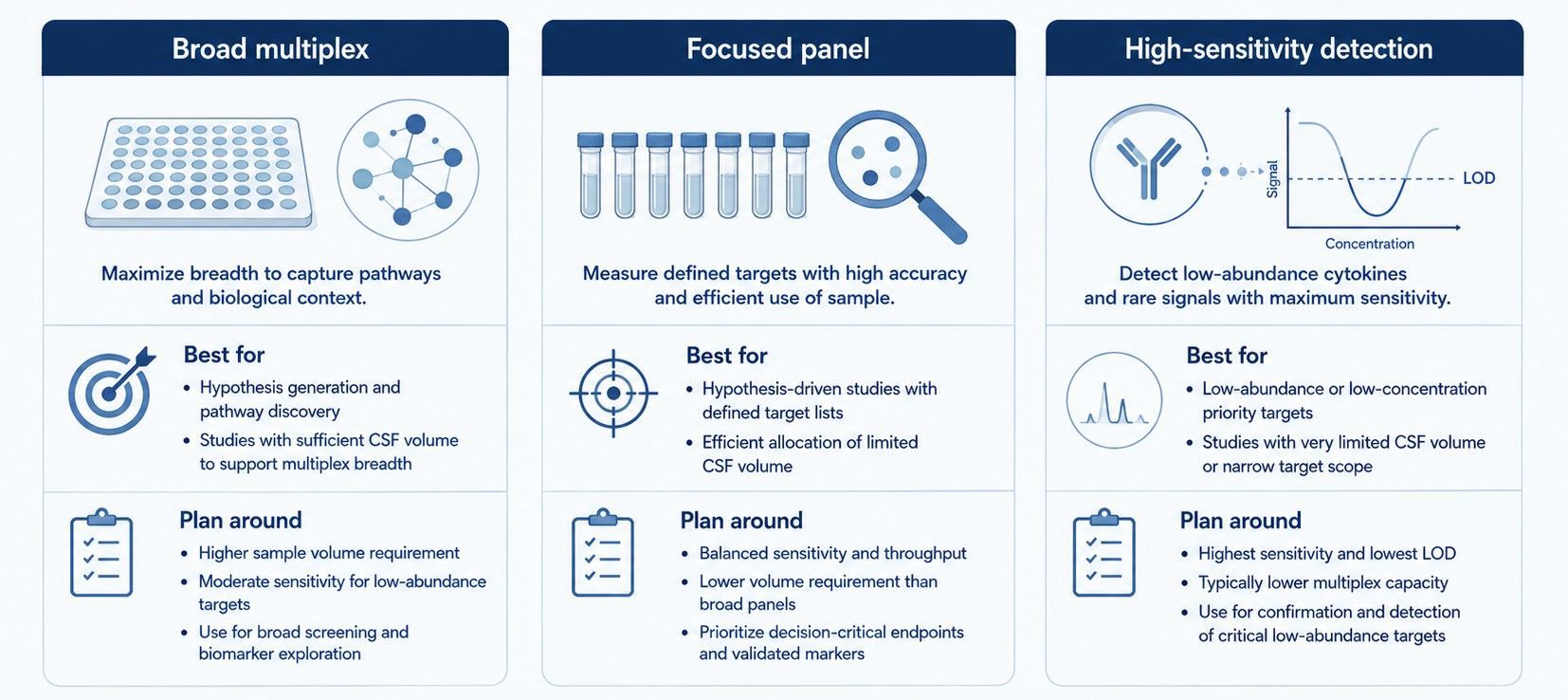 Platform choice for CSF cytokine profiling should follow primary targets, available volume, and expected range.
How to Report CSF Cytokine Data So It Remains Interpretable
A complete CSF cytokine result set should contain the reported concentration and its qualifier, the assay dilution, the CSF aliquot identifier, relevant handling metadata, and a record of any matrix-quality rule applied to the sample. For multi-batch analysis, add plate, run, bridge material, and any re-run information.
Do not hide low-detection patterns by converting all non-quantifiable measurements into one arbitrary number. Retain the original flags and specify the analysis and visualization rule before group comparisons. This is especially important for CSF, where detection patterns may be biologically informative but can also reflect platform range and sample history.
For repeated batches or a growing CSF archive, use a planned bridge-control scheme and avoid assigning all samples from one collection period to a separate analytical run. The cytokine bridge-controls and batch-QC guide gives related guidance for protecting analytical comparability.
A Practical CSF Sample Manifest and Allocation Ledger
A CSF sample manifest should identify the experimental unit, aliquot lineage, volume available at receipt, volume assigned to each assay, collection and processing metadata, storage record, and any quality observation. The allocation ledger should also reserve a contingency volume when a primary result may need repeat measurement or confirmation. This record prevents an apparent analytical failure from becoming an irreversible volume shortage.
Review the ledger again after feasibility work. If decision-critical targets are below range or if planned dilution compromises their recovery, redirect the remaining material toward a focused method rather than continuing with the original broad allocation by default. That decision is easier when the project has retained a dedicated aliquot and has not fragmented the available volume across too many exploratory tests.
Common CSF Cytokine Profiling Mistakes
- Using all available CSF for an exploratory panel before reserving material for primary targets or follow-up.
- Applying a plasma dilution rule to CSF without CSF-specific feasibility evidence.
- Choosing a broad panel based on analyte count rather than decision-critical coverage.
- Ignoring handling history, potential blood contribution, and aliquot lineage in the result file.
- Combining samples with different storage or matrix histories without a stated comparability boundary.
- Treating values below the reporting range as precise quantitative results after transformation.
Planning a CSF Cytokine Profiling Project
For project scoping, provide available volume per sample, sample count, collection matrix and handling history, storage and freeze–thaw information, potential blood contribution observations, the primary biological question, decision-critical cytokines, desired pathway breadth, and whether material must be retained for another assay. These details allow an allocation plan and feasibility design to be matched to the actual CSF resource.
Creative Proteomics can support CSF cytokine study planning through multiplex cytokine detection, focused panel design, and high-sensitivity options where justified by the expected range and sample volume. The objective is a CSF data package that preserves limited material for the questions that matter, while retaining the matrix and handling context needed to interpret the results.
CSF Cytokine Study Design Checklist
Before testing, create a sample-volume ledger; rank targets by decision importance; specify the planned panel or focused assay; record collection, storage, aliquot, and quality metadata; choose a CSF-relevant feasibility set; define the reporting rule for results outside the useful range; and reserve material for essential confirmation if the study requires it.
Use broad multiplexing when CSF volume and expected range support pathway discovery. Use focused or high-sensitivity detection when a small set of low-abundance targets determines the conclusion. In both cases, treat CSF handling and matrix context as part of the measurement, not as background detail.
Frequently Asked Questions
How much CSF is needed for multiplex cytokine profiling?
The required volume depends on the panel, concentration range, planned dilution, replicates, and whether confirmatory testing is needed. Start with the available volume and decision-critical analytes so an allocation plan can protect the primary question.
Should CSF cytokine samples be diluted before multiplex analysis?
Use dilution only when it is supported by a CSF-relevant feasibility assessment and the expected range of critical analytes. A dilution that protects one abundant target may make low-abundance cytokines less informative.
When is a high-sensitivity cytokine platform needed for CSF?
Consider it when decision-critical targets are expected near the lower reporting range, available CSF volume is limited, or a broad conventional panel is unlikely to provide useful coverage. Platform selection should be based on targeted feasibility evidence, not a sensitivity claim alone.
Can blood contamination affect CSF cytokine measurements?
Yes, blood-associated proteins or cells can alter the matrix and complicate interpretation. Record the sample appearance and relevant collection metadata, then use a preplanned rule for inclusion, stratification, or qualification.
How should CSF samples be stored before cytokine analysis?
Use a consistent, documented handling route with prompt cooling or freezing as appropriate for the project. Evidence for stability is analyte-specific, so do not assume that all cytokines tolerate the same delays or repeated handling.
Can the same cytokine panel be used for plasma and CSF?
The same assay may be technically possible, but the matrices and expected concentration distributions are different. Evaluate CSF as its own matrix and do not transfer plasma dilution or QC assumptions without verification.
References:
- Møller M, et al. The effect of pre-analytical handling on the stability of fractalkine, MCP-1, IL-6 and IL-8 in samples of human cerebrospinal fluid. Journal of Immunological Methods. 2021;495:113057.
- Tan YC, et al. Impact of cerebrospinal fluid sample handling on cytokine detection results. Annals of Clinical and Laboratory Science. 2022;52:470–474. PMID: 35777804.
- Parkitny L, et al. Multiplex cytokine concentration measurement: how much do the medium and handling matter? Mediators of Inflammation. 2013;2013:890706.
- Breen EJ, et al. Comparison of bead-based fluorescence versus planar electrochemiluminescence multiplex immunoassays for measuring cytokines in plasma. Journal of Immunological Methods. 2020. PMID: 33101295.
- Lee JW, et al. Fit-for-purpose method development and validation for successful biomarker measurement. Pharmaceutical Research. 2006;23:312–328.