
Most multiplex cytokine panels are validated for serum and plasma — but researchers studying neurodegeneration, mucosal immunity, or tissue inflammation often need to measure cytokines in saliva, cerebrospinal fluid, bronchoalveolar lavage fluid, or tissue lysates. Whether a panel designed for blood works in these matrices depends on analyte concentration, matrix-specific interference, and dilution-response linearity.
This guide explains when a matrix qualification study is necessary, which matrices present the most common challenges, and how dilution linearity, parallelism, and spike recovery testing determine whether a nonstandard sample type is suitable for a multiplex cytokine assay.
For guidance on selecting the right panel before matrix qualification begins, see our guide to choosing Luminex cytokine panels, which covers panel selection, platform considerations, and validation criteria for different sample types.
When Does a Multiplex Cytokine Assay Need Matrix Qualification?
Matrix qualification verifies that the assay performs reproducibly and fit for purpose in a specific sample matrix, without unacceptable bias from matrix interference, dilution behavior, or inadequate analytical sensitivity.
Qualification is recommended when the sample type differs from serum or plasma in any of the following ways: it contains matrix-specific interferents such as mucins, proteases, surfactant lipids, cellular debris, or variable lavage dilution (saliva, BALF); it has analyte concentrations near or below the lower limit of quantification of standard panels (CSF); it is generated by homogenizing solid tissue in a buffer containing detergents or protease inhibitors (tissue lysates); or it has been supplemented with serum or growth factors that introduce exogenous proteins (culture supernatants).
If the matrix has been previously validated by the assay manufacturer for the specific panel being used, qualification may not be necessary. If no prior data exist, a pilot qualification study is the safest path to reliable results. Even for serum and plasma — which are well-characterized but not interference-free — performance remains panel- and analyte-dependent, with documented matrix effects including anticoagulant-dependent signal variation, heterophilic antibody interference, complement-mediated inhibition, and donor-dependent nonlinear dilution behavior (Rosenberg-Hasson et al., 2014).
A Risk Map for Common Nonstandard Matrices
Each matrix presents a distinct profile of analytical challenges. Understanding these before submitting samples helps set realistic expectations and informs experimental design.
| Matrix | Expected Cytokine Concentration | Main Interference Risks | Typical Qualification Needs |
|---|---|---|---|
| Serum / Plasma (reference) | pg/mL to ng/mL range | Well-characterized but not interference-free; anticoagulants, hemolysis, heterophilic antibodies, complement, donor-dependent matrix effects | No additional matrix qualification may be required for validated panel–matrix combinations; study-specific verification may still be appropriate |
| Saliva | Lower than serum; highly variable | Mucins, viscosity, oral bacterial proteases, collection method variability, blood contamination | Clarification by centrifugation; dilution linearity; spike recovery |
| CSF | Varies by analyte and disease context; many cytokines near or below panel LLOQ | Very low protein; variable detectability across analytes | Parallelism; sensitivity verification; may require neat testing with panel-specific LLOQ assessment |
| BALF | Variable; depends on lavage volume and recovery | Lavage-induced dilution; surfactant lipids; mucus and debris; recovery variability | Normalization strategy (total protein or urea); spike recovery; dilution linearity |
| Tissue / Organ Lysates | Depends on tissue and homogenization buffer | Lysis buffer components (detergents, protease inhibitors, reducing agents); total protein load | Buffer compatibility testing; spike recovery; parallelism at multiple dilutions |
| Culture Supernatants | Wide range depending on stimulation conditions | Serum in culture media (FBS); media components that may contribute to background | Media blank subtraction; evaluated with matched media blanks |
Saliva
Saliva is one of the most frequently requested nonstandard matrices for cytokine analysis. Its main challenges are high viscosity from mucins, which can interfere with bead-based capture or Luminex flow cell performance, and the presence of oral bacterial proteases that may degrade target proteins during collection. Collection method — passive drool versus stimulated saliva — can also affect analyte concentrations. Centrifugation at high speed after collection removes particulates and reduces viscosity. For analytes present at very low concentrations, running samples without dilution may be the only option, but this increases the risk of matrix interference. For projects specifically using saliva, our saliva cytokine assay supports matrix-aware Luminex testing strategies for saliva samples, with pilot qualification available when required.
CSF
Cerebrospinal fluid has approximately 200-fold lower total protein than serum, and many cytokines occur near or below the LLOQ of standard serum/plasma panels. Detectability is strongly analyte- and disease-context-dependent — some cytokines may be undetectable in healthy CSF but become measurable under neuroinflammatory conditions. Researchers should verify that their targets of interest are measurable in CSF before committing to a large study, and consider panels with extended low-end sensitivity or customized standard curves for this matrix (Martins et al., 2024).
BALF
Bronchoalveolar lavage fluid is inherently diluted — the instilled saline that recovers airway contents also dilutes resident cytokines by a factor that varies between subjects and lavage sites. Urea dilution correction or normalization to total protein can reduce this variability. Surfactant lipids may interfere with bead-based capture, and spike recovery testing is recommended to confirm that added standards are quantitatively recovered.
Tissue and Organ Lysates
Lysates generated from brain, lung, liver, lymph node, or other tissues introduce a unique variable: the lysis buffer. Detergent tolerance is kit-specific. For some bead-based assays, tissue lysates must be diluted sufficiently to reduce the final detergent concentration to approximately 0.01% or below; the acceptable concentration should be confirmed against the selected panel and assay buffer. Protease inhibitors and reducing agents in the lysis buffer may also affect assay performance. Testing the buffer alone at working concentration against the standard curve is a simple way to identify detergent interference before the full study.
Culture Supernatants
Cell culture supernatants are among the less problematic nonstandard matrices, but two issues warrant attention. Fetal bovine serum used in culture media contains bovine cytokines and growth factors that may cross-react with the assay antibodies, producing false-positive signals. Certain media components may contribute to background signal and should be evaluated with matched media blanks incubated under the same conditions as the experimental wells.
Dilution Linearity and Parallelism
Dilution linearity and parallelism are the two most informative tests in a matrix qualification study, and they are often confused. Dilution linearity asks whether the measured concentration of an endogenous analyte decreases proportionally when the sample is serially diluted. A matrix with good dilution linearity produces a straight line when the reciprocal of the dilution factor is plotted against the measured concentration; deviation from linearity indicates that the matrix is interfering with the assay response in a dilution-dependent manner.
Parallelism asks whether the dilution curve of the biological sample runs parallel to the standard curve. If the sample curve is shallower or steeper, the assay response differs between the calibrator and sample matrices, indicating potential matrix interference or analyte-dependent response differences. Samples that fail parallelism may still be usable if quantified against a matrix-matched calibration curve, but this adds complexity and cost to the assay.
Three to five in-range serial dilutions are commonly evaluated, depending on endogenous concentration, assay dynamic range, and sample availability. Some low-abundance CSF samples may not support multiple valid dilution points.
Spike Recovery and Interference Testing
Spike recovery measures whether a known amount of analyte added to the sample matrix is quantitatively recovered. Acceptance criteria should be defined before testing. Depending on the intended use, analyte, and assay maturity, commonly used research ranges include 70–130% or the more stringent 80–120% (Jani et al., 2016). Recovery below the defined range suggests that matrix components are blocking antibody binding or that the analyte is being degraded; recovery above the range suggests that matrix components are enhancing the signal or that the spike is displacing endogenous analyte from binding proteins.
Interference testing extends this by evaluating whether specific matrix components — detergents, reducing agents, or high concentrations of heterophilic antibodies — affect assay performance. For tissue lysates, testing the lysis buffer alone at working concentration against the standard curve is a simple way to identify detergent interference. For saliva and BALF, the key question is whether centrifugation or filtration improves recovery.
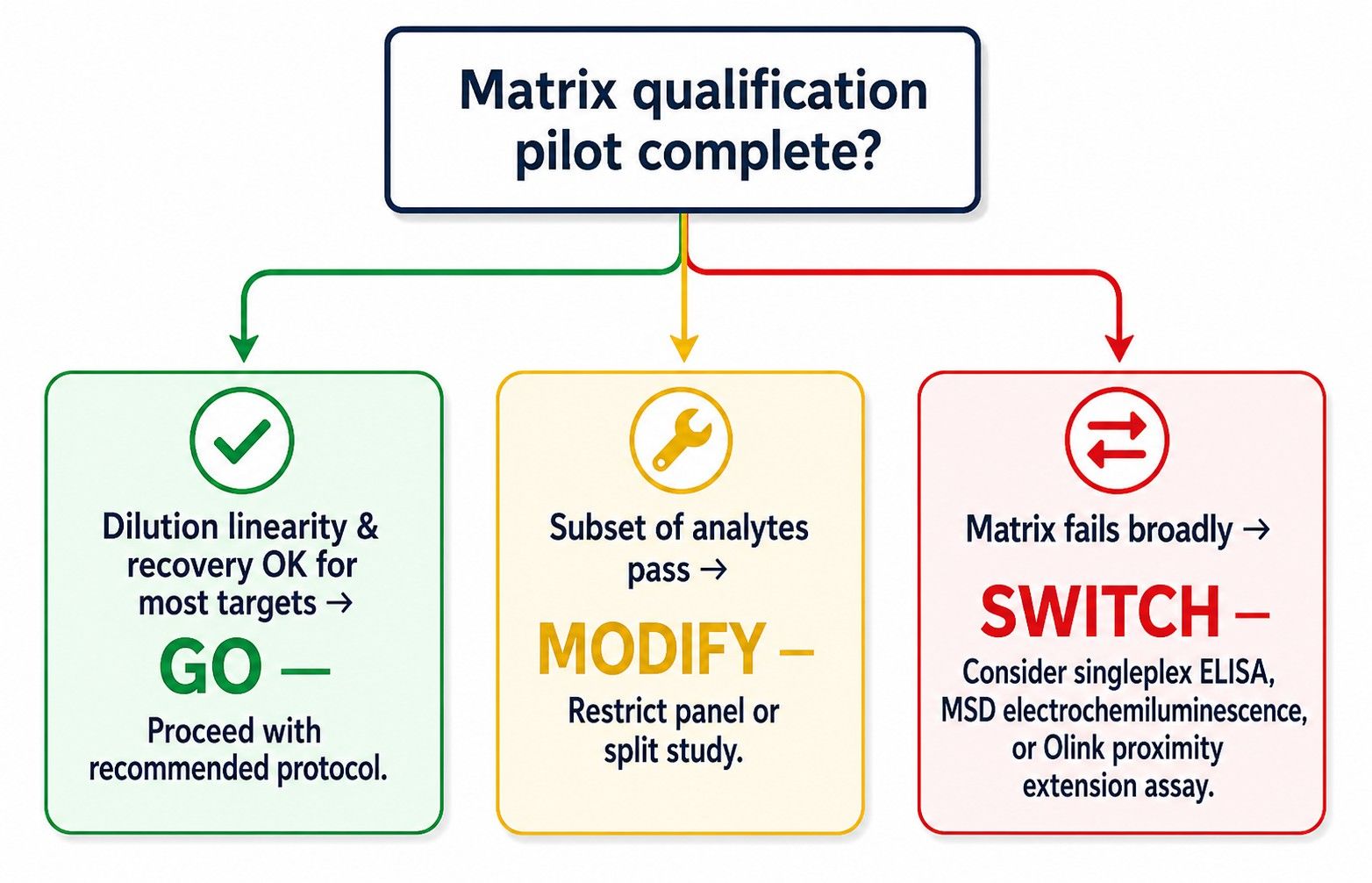 Matrix qualification workflow: collect representative samples, test dilution linearity and spike recovery, evaluate parallelism, then make a go/modify/switch decision based on the data.
Designing a Pilot Qualification Study
The pilot should include enough representative samples to capture expected matrix variability. The design should cover serial dilutions spanning the assay's working range for each test sample, spike recovery experiments using a mid-range concentration of each analyte, and a neat media or buffer blank for culture supernatants and lysates.
If the pilot data show acceptable dilution linearity and spike recovery for most analytes in the panel, the matrix can be used in the full study with the recommended dilution and processing steps. If only a subset of analytes pass, the panel may need to be split or restricted to those targets. If most analytes fail, the matrix may not be suitable for multiplex analysis, and singleplex assays or alternative detection platforms should be considered.
Not sure whether your matrix is compatible with a multiplex cytokine panel? Share your sample type, species, target analytes, available volume, and collection buffer for a feasibility review with our Luminex assay team.
Go, Modify, or Switch Methods?
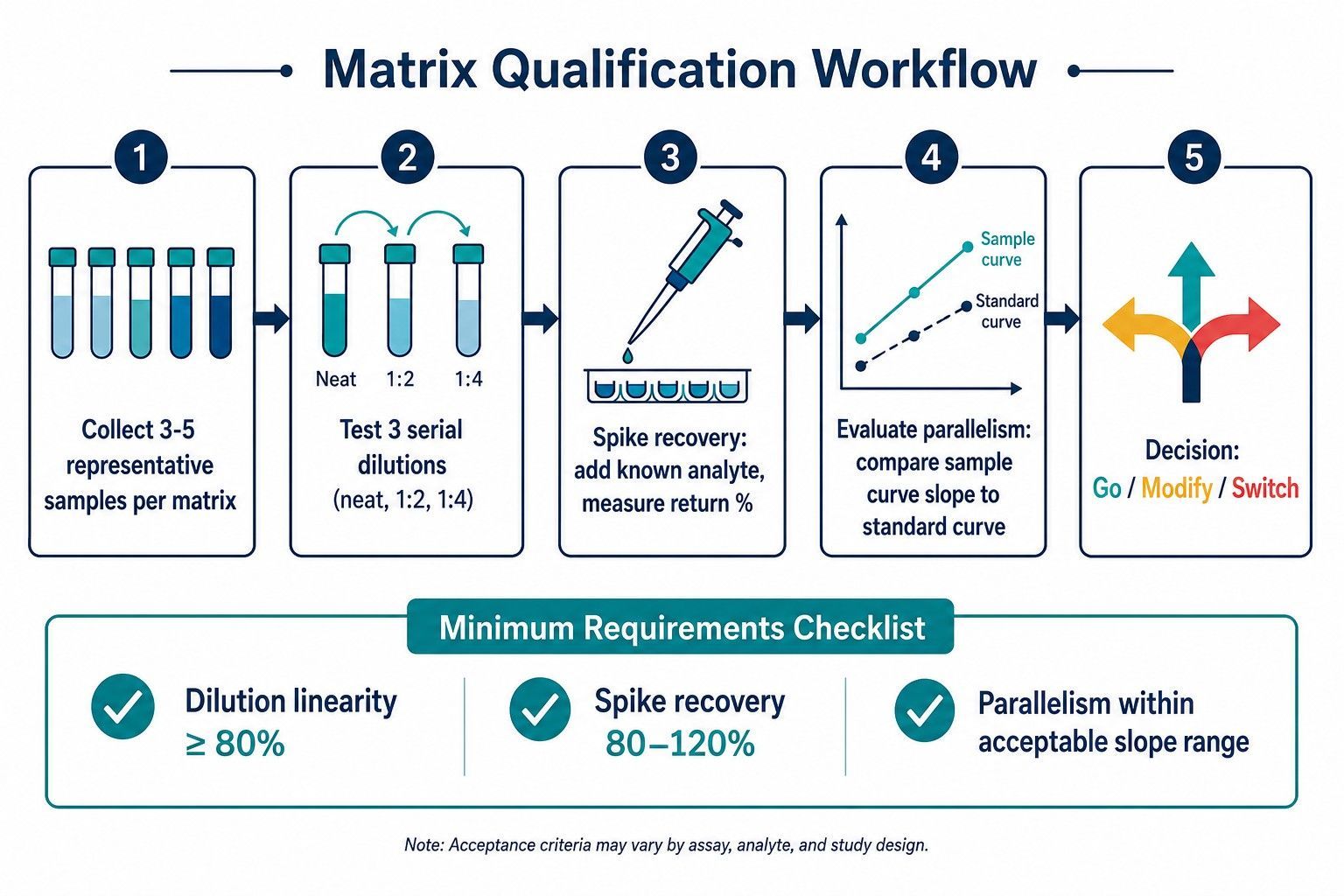 Decision framework for matrix qualification: if linearity and recovery pass for most targets, proceed. If only a subset pass, modify the panel. If the matrix fails broadly, consider singleplex or alternative platforms.
The decision after a pilot falls into three categories. Go: dilution linearity and spike recovery are within acceptable ranges for most or all targets. Proceed with the full study using the recommended dilution and processing protocol. Modify: only a subset of analytes pass qualification. Restrict the panel to those targets, or split the study into validated and unvalidated analyte groups with the appropriate caveats for the latter. Switch: matrix interference is pervasive across multiple analytes, even after optimization. At this point, singleplex ELISA or alternative platforms such as electrochemiluminescence (MSD) or proximity extension assays (Olink) may provide better matrix compatibility for the specific sample type.
What a Matrix Qualification Pilot Can Deliver
Depending on the selected qualification scope, deliverables may include:
- Recommended minimum required dilution for the specific matrix
- Analyte-level detectability assessment
- Dilution linearity results
- Parallelism evaluation against the standard curve
- Spike-recovery results per analyte
- Buffer or media interference assessment
- Go / Modify / Switch recommendation with supporting data
- Suggested sample preparation protocol for the full study
- Full-study sample volume estimate based on pilot data
Sample Submission and Project Information Checklist
Before submitting nonstandard matrix samples for multiplex cytokine analysis, providing the following information helps the testing laboratory evaluate panel compatibility and recommend a fit-for-purpose pilot strategy:
- Species and sample matrix type
- Target analyte list
- Number of samples planned for the full study
- Available volume per sample
- Collection method and storage conditions
- Freeze-thaw history
- Buffer or media composition (for lysates and supernatants)
- Expected concentration range, if known from prior data
For custom Luminex panel design and matrix-specific testing, our Luminex multiplex assay customization service supports both standard and custom panels with matrix qualification options.
Plan a Matrix Qualification Pilot. Submit your matrix type, analyte list, sample number, available volume, and storage conditions to our Luminex cytokine panel service team. Our scientists will evaluate panel compatibility and recommend a fit-for-purpose pilot strategy tailored to your sample type and research goals.
FAQs
1) How much sample is needed for a matrix qualification pilot?
Sample volume requirements depend on the selected panel, number of replicates, dilution series design, and whether spike-recovery testing is included. Please provide the available volume per sample so that a matrix-specific pilot design can be calculated before shipment.
2) What is the difference between spike recovery and parallelism?
Spike recovery measures whether a known quantity of analyte added to the sample is returned by the assay. Parallelism compares the slope of the sample dilution curve to the standard curve slope. Recovery detects matrix interference with antibody binding; parallelism detects differences in binding kinetics between the calibrator and sample matrices.
3) Can saliva samples be used directly in a standard serum-validated Luminex panel?
Not without qualification. Saliva contains mucins and proteases that can affect bead-based capture. Centrifugation to remove particulates and dilution linearity testing are recommended before using saliva in a multiplex panel designed for serum or plasma.
4) Does tissue lysate buffer composition affect multiplex assay results?
Yes. Detergent tolerance is kit-specific. For some bead-based assays, tissue lysates must be diluted sufficiently to reduce the final detergent concentration to approximately 0.01% or below. Testing the buffer alone against the standard curve identifies detergent interference before the full study.
5) What should I do if only some analytes pass qualification in my matrix?
Restrict the panel to those targets that passed, or split the study and report unvalidated analytes with appropriate caveats. If a critical target fails, consider measuring it by singleplex ELISA or an alternative detection platform designed for that specific matrix.
References
- Rosenberg-Hasson, Y., et al. (2014). Effects of serum and plasma matrices on multiplex immunoassays. Immunologic Research, 58(2-3), 224–233. PMCID: PMC4332596
- Martins, T. B., Hill, H. R., and Peterson, L. K. (2024). Specimen type validation and establishment of normal cytokine reference intervals in cerebrospinal fluid. Journal of Immunological Methods, 529, 113681. DOI: 10.1016/j.jim.2024.113681
- Jani, D., et al. (2016). Recommendations for use and fit-for-purpose validation of biomarker multiplex ligand binding assays in drug development. The AAPS Journal, 18(1), 1–14. DOI: 10.1208/s12248-015-9820-y
- Thermo Fisher Scientific. Custom ProcartaPlex Multiplex Panel — Frequently Asked Questions. Thermo Fisher Scientific FAQ
- Riis, J. L., et al. (2021). Best practice recommendations for the measurement and interpretation of salivary proinflammatory cytokines in biobehavioral research. Brain, Behavior, and Immunity, 91, 105–116. DOI: 10.1016/j.bbi.2020.09.009