Ultra-Sensitive Electrochemiluminescence (ECL) Assays for Alzheimer's, Parkinson's, Multiple Sclerosis, Traumatic Brain Injury & Neuroinflammation Research.
From single-marker ultrasensitive S-PLEX assays to comprehensive 37-plex neuroinflammation panels — our ECL platform supports a broad range of neurodegenerative disease research applications, from target discovery through therapeutic development and cohort studies.
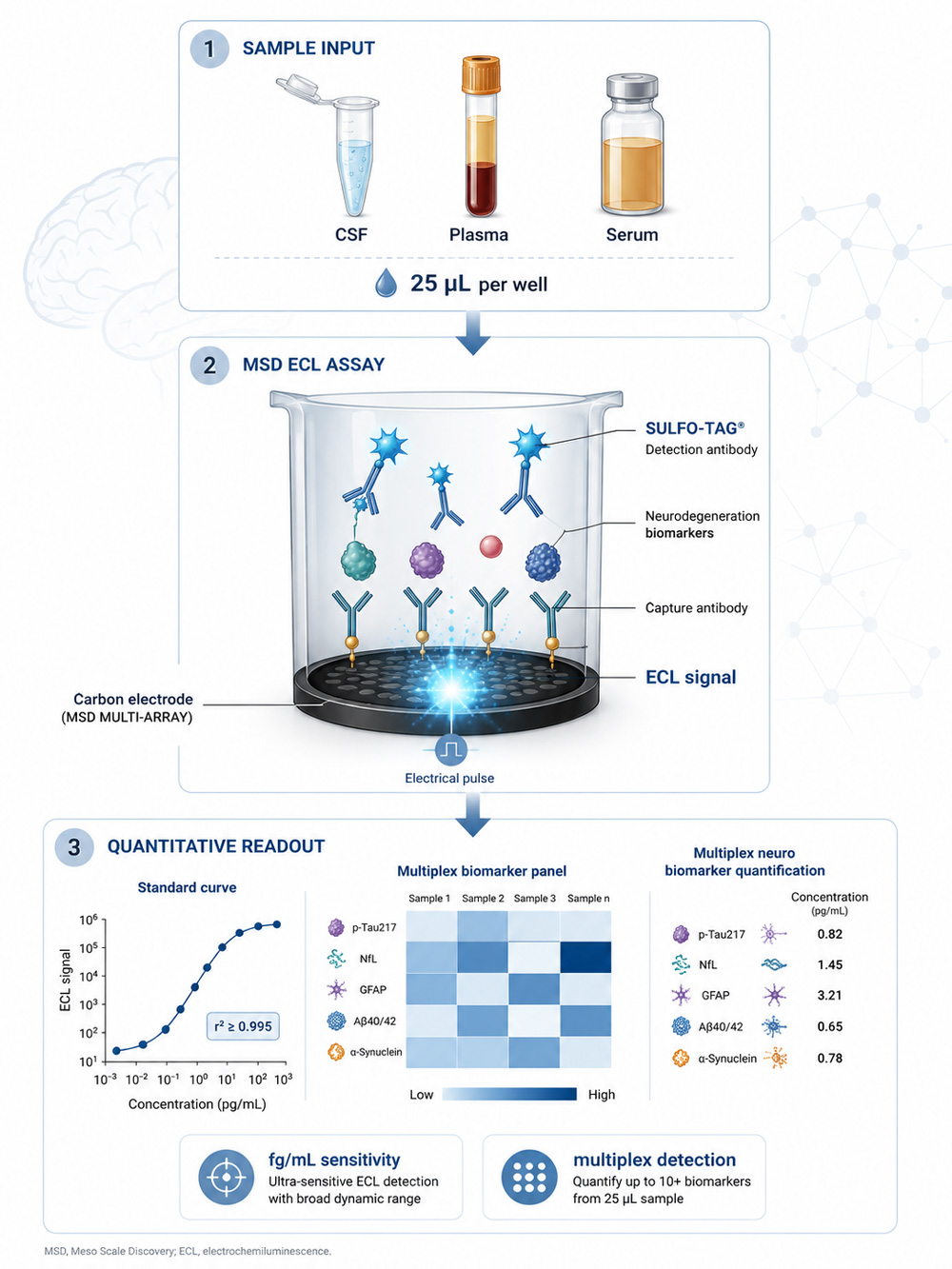
Neurodegenerative diseases present a unique analytical challenge — many research-relevant biomarkers circulate at sub-picogram per milliliter concentrations in blood and CSF. MSD's electrochemiluminescence (ECL) technology offers fg/mL-level sensitivity, making it a powerful platform for quantifying low-abundance neurological biomarkers that traditional ELISA or bead-based multiplex assays cannot reliably measure. This is critical for longitudinal cohort studies, therapeutic development programs, and preclinical research where subtle biomarker changes carry significant biological meaning.
51+ pre-configured MSD panels for neurodegeneration research — from single-plex ultrasensitive assays to comprehensive multiplex profiling. All available as full-service (sample-to-data) or kit-only options.
| Panel / Service | Key Analytes | Species | Type | Sensitivity |
|---|---|---|---|---|
| MSD p-Tau217 Ultrasensitive Assay | p-Tau217 | Human | Service / Kit | fg/mL (S-PLEX) |
| MSD NfL (Neurofilament Light) Assay | Neurofilament L (NfL) | Human NHP | Service / Kit | fg/mL (S-PLEX) |
| MSD GFAP Assay | GFAP | Human NHP | Service / Kit | fg/mL (S-PLEX) |
| MSD Tau (pT231) Ultrasensitive Assay | Tau (pT231) | Human NHP | Service / Kit | fg/mL (S-PLEX) |
| MSD Tau (pT181) Ultrasensitive Assay | Tau (pT181) | Human NHP | Service / Kit | fg/mL (S-PLEX) |
| MSD Aβ40/Aβ42 Assay | Aβ38, Aβ40, Aβ42 (6E10 & 4G8) | Human Mouse Rat | Service / Kit | pg/mL |
| MSD α-Synuclein Assay | α-Synuclein | Human | Service / Kit | pg/mL |
| MSD BDNF Assay | BDNF | Human | Service / Kit | pg/mL |
| MSD Neurodegeneration 3-Plex (Ultrasensitive) | GFAP, Neurofilament L, Tau (total) | Human NHP | Service / Kit | fg/mL |
| MSD Tau & p-Tau 2-Plex Panel | Tau (Total), Tau (pT231) | Human | Service / Kit | fg/mL |
| MSD Aβ 3-Plex Panel (6E10) | Aβ38, Aβ40, Aβ42 (6E10) | Human | Service / Kit | pg/mL |
| MSD Aβ 3-Plex Panel (4G8) — Multi-Species | Aβ38, Aβ40, Aβ42 (4G8) | Multi-Species | Service / Kit | pg/mL |
| MSD Alzheimer's Disease Research 10-Plex | IL-16, MIF, Eotaxin, IL-1α, IL-12/IL-23p40, IL-17A, MCP-1, MDC, SDF-1α, YKL-40 | Human | Service / Kit | pg/mL |
| MSD Neuroinflammation 37-Plex | CRP, Eotaxin, Eotaxin-3, FGF(basic), ICAM-1, IFN-γ, IL-1α, IL-1β, IL-2, IL-4, IL-5, IL-6, IL-7, IL-8, IL-10, IL-12/IL-23p40, IL-13, IL-15, IL-16, IL-17A, IP-10, MCP-1, MCP-4, MDC, MIP-1α, MIP-1β, PlGF, SAA, TARC, Tie-2, TNF-α, TNF-β, VCAM-1, VEGF-A, VEGF-C, VEGF-D, VEGFR-1/Flt-1 | Human | Service / Kit | sub-pg/mL |
| MSD Multiple Sclerosis Research 9-Plex | IL-7, CTACK, Fractalkine, GRO-α, IL-12/IL-23p40, IP-10, MCP-1, MIP-1β, MIP-3α | Human | Service / Kit | pg/mL |
| MSD Traumatic Brain Injury Research 10-Plex | IFN-γ, IL-6, TNF-α, VEGF-D, RANKL/TNFSF11, CD40L(soluble), Fractalkine, IL-1β, IL-18, MCP-1 | Human | Service / Kit | pg/mL |
| NHP Neurodegeneration 3-Plex (Ultrasensitive) | GFAP, Neurofilament L, Tau (total) | NHP | Service / Kit | fg/mL |
| NHP Tau (pT231 / pT181) Ultrasensitive Assay | Tau (pT231), Tau (pT181) | NHP | Service / Kit | fg/mL |
| NHP NfL & GFAP Ultrasensitive Assay | NfL, GFAP | NHP | Service / Kit | fg/mL |
Panel availability should be confirmed during project consultation. The panels listed represent our current MSD assay portfolio — contact us for the latest additions. Custom configurations and species cross-reactivity assessments available upon request. All services are for research use only.
Our MSD platform supports the most intensively studied biomarkers in neurodegeneration research.
Phosphorylated Tau at threonine 217 — a leading blood-based biomarker for Alzheimer's disease research. Detected at fg/mL levels via S-PLEX technology. Widely used in cohort enrichment for therapeutic trials.
A general marker of axonal injury studied across multiple neurodegenerative conditions — AD, MS, ALS, FTD, TBI. fg/mL ultrasensitive quantification in serum, plasma, and CSF for longitudinal research.
Glial fibrillary acidic protein — a marker of astrocyte activation investigated in Alzheimer's, TBI, and neuroinflammation research. Ultrasensitive fg/mL detection enables blood-based astrogliosis studies.
Total Tau, p-Tau181, p-Tau231 — a comprehensive Tau phosphorylation profile for Alzheimer's pathology research and therapeutic target engagement studies.
Amyloid-beta peptides — central to Alzheimer's pathology research. Available with 6E10 (human) and 4G8 (multi-species) antibody clones. Aβ42/Aβ40 ratio for research use.
A key protein investigated in Parkinson's disease and synucleinopathy research. Sensitive quantification in CSF and evolving blood-based research applications.
Start with your research goal — we'll help you find the right assay configuration.
S-PLEX V-PLEX
p-Tau217 · p-Tau181/p-Tau231 · Aβ40/Aβ42 · AD Research 10-Plex
S-PLEX
NfL — cross-disease axonal degeneration marker for MS, ALS, TBI, and AD research
S-PLEX
GFAP — astrocyte-specific marker for TBI, Alzheimer's-related astrogliosis, and neuroinflammation
V-PLEX
Neuroinflammation 37-Plex — cytokines, chemokines, vascular markers, and growth factors
S-PLEX V-PLEX
α-Synuclein for disease-specific pathology + Neuroinflammation 37-Plex for inflammatory context
NHP-Validated
NHP-compatible S-PLEX and V-PLEX assays for p-Tau, NfL, GFAP. Contact us for species-specific feasibility.
Not sure which panel fits your study? Contact our scientific team for a free consultation — we'll help you design the optimal assay configuration.
How electrochemiluminescence enables the sensitivity required for low-abundance neuro biomarker studies.
A standardized 5-step process — from study design consultation to data delivery.
Discuss your research objectives with our scientific team. We help select appropriate biomarker panels, determine sample size requirements, and finalize the experimental design aligned with your study goals.
Ship your serum, plasma, or CSF samples following our collection guidelines. Minimum 25 µL per sample. Samples are accessioned, aliquoted, and stored at −80°C upon receipt with full chain-of-custody documentation.
Assays performed on MESO QuickPlex SQ 120 or MESO SECTOR S 600 instruments. Each plate includes 8-point standard curves, QC controls, and blank wells. All runs follow documented SOPs.
Raw ECL signals acquired via MESO Discovery Workbench. QC acceptance criteria: intra-plate CV <10%, inter-plate CV <15%, standard curve R² ≥ 0.99. Values outside the calibration range are flagged for re-analysis at appropriate dilution.
Comprehensive report including analyte concentrations, QC metrics, standard curve plots, raw ECL signal data, and a methods summary suitable for publication. Data delivered in Excel and PDF formats.
Collection protocols and practical guidance for sample preparation and shipment.
Collect in serum separator tubes (SST). Allow 30 min clotting at RT. Centrifuge at 1,500×g for 10 min. Aliquot and freeze at −80°C. Volume requirements vary by panel — typically 50–200 µL per aliquot. We'll confirm the exact amount after panel selection.
Collect in EDTA tubes. Centrifuge within 30 min at 1,500×g for 10 min. Transfer supernatant, aliquot, and freeze at −80°C. Volume varies by panel size and replication needs — we'll advise during study design. Heparin and citrate tubes also acceptable for most panels.
Collect in polypropylene tubes. Centrifuge at 2,000×g for 10 min at 4°C. Aliquot immediately and store at −80°C. Low-volume compatible — as little as 25 µL per well. Discuss minimum viable volume with our team for your specific panel.
Shipping: Samples should be shipped on dry ice via overnight courier. We provide sample collection kits (tubes, labels, shipping containers) upon request. International shipments: contact us for customs documentation support.
Avoid repeated freeze-thaw cycles. Note freeze-thaw count on each aliquot. Hemolyzed or lipemic samples may affect certain analytes — we'll flag any concerns during QC review rather than silently excluding data.
Every MSD assay engagement includes a complete data package designed for research documentation and publication.
Analyte concentrations for all samples with QC metrics (intra-plate CV, inter-plate CV), standard curve parameters (R², back-fit accuracy), and LOD/LLOQ values per analyte. Delivered in Excel (.xlsx) and PDF formats.
Raw ECL signal values for every well, 8-point standard curve plots with fitted curves, QC sample trend charts, and plate layout maps for full traceability. Compatible with downstream analysis in R, Python, or GraphPad Prism.
A detailed methods section describing assay protocol, reagents, instrument settings, and acceptance criteria — formatted for direct inclusion in manuscript Methods sections or supplementary materials.
What sets our MSD service apart — beyond the platform's inherent capabilities.
Every project is assigned a lead scientist who consults on panel selection, sample preparation, and data interpretation. Direct communication — no sales handoff after contract signing.
Choose full-service (sample-to-report) or kit-only delivery. Custom panel configurations via U-PLEX. Same-day re-runs at no extra charge for QC failures. Adjust scope mid-study as research questions evolve.
Project timelines aligned to your study schedule. Expedited options available for time-sensitive studies. Real-time status updates throughout the project lifecycle.
We track reagent lots and instrument conditions across your projects. Re-analyze stored samples when new panels become available. Long-term data archiving with secure retrieval for multi-year studies.
Methods-ready documentation, figure-ready plots, and statistical consultation. Our clients routinely publish in high-impact journals using data generated on our MSD platform.
Every plate includes multi-level QC samples with pre-defined acceptance windows. Lot-to-lot reagent bridging for longitudinal studies. Detailed deviation reports when values fall outside expected ranges — no silent data delivery.
S-PLEX is MSD's ultrasensitive assay format achieving fg/mL-level detection — approximately 10–100× more sensitive than standard MSD assays. It incorporates an enhanced signal amplification step specifically designed for low-abundance biomarkers like p-Tau217, NfL, and GFAP in blood. Standard MSD assays typically achieve LODs in the 0.05–1 pg/mL range, which is sufficient for most cytokines, chemokines, and moderately abundant proteins.
CSF provides the highest biomarker concentrations and is closest to the brain compartment, making it valuable for CNS-focused studies. For large-scale cohort studies and longitudinal trials, blood (serum or plasma) is more practical. Thanks to MSD's fg/mL sensitivity, biomarkers like p-Tau217 and NfL can now be reliably measured in blood. We generally recommend EDTA plasma for most neuro biomarker applications, as it has shown good correlation with CSF measurements across published studies. Serum is also acceptable for most panels. We advise using the same matrix consistently within a given study.
Both MSD S-PLEX and Simoa (Quanterix) achieve fg/mL sensitivity. Key differences for research applications: MSD uses electrochemiluminescence with carbon electrode plates and SULFO-TAG labels — providing a wider dynamic range (6 logs) and stable signal independent of light exposure. MSD also supports multiplexing (up to 10-plex). Simoa uses single-molecule counting in femtoliter-volume wells — offering very low LOD for certain analytes but typically limited to 1–4 plex. For studies requiring multiplexed neuro biomarker panels alongside ultrasensitive single markers, MSD offers greater workflow efficiency. See our MSD vs Simoa comparison page for detailed platform analysis.
Yes. Through the MSD U-PLEX platform, you can create custom panels with any 2–10 analytes from our available neuro biomarker catalog. Each U-PLEX assay uses individually coated linker-coupled antibodies, providing full flexibility in panel design. Our scientific team can help evaluate analyte compatibility and optimize the multiplex configuration. Custom assay development for novel targets is also available through our R-PLEX and custom development services.
Every MSD assay includes: (1) 8-point standard curve with R² and back-fit accuracy; (2) QC samples (low, medium, high) on each plate; (3) intra-plate CV for each analyte; (4) inter-plate CV for multi-plate studies; (5) LOD and LLOQ determination per analyte; (6) raw ECL signal data; (7) dilution linearity verification for the sample matrix. Full validation documentation is available for V-PLEX panels.
Online Inquiry
×