Multiplex electrochemiluminescence assays for gut hormones, adipokines, insulin signaling proteins, and metabolic biomarkers — from focused 2-plex panels to the 87-plex metabolic discovery platform, across human, mouse, rat, and NHP.
Metabolic biomarker quantification presents unique pre-analytical challenges not encountered in other research areas: GLP-1 and glucagon are rapidly degraded by endogenous DPP-IV and other proteases ex vivo, requiring immediate blood processing with specific protease inhibitors. Ghrelin exists in active (acylated) and inactive (des-acyl) forms requiring distinct assays. Insulin, C-peptide, and proinsulin must be measured together to distinguish endogenous secretion from exogenous administration. Our MSD metabolic assay service addresses these challenges with standardized protease-inhibitor collection protocols, active/total isoform-specific assays, and pre-configured multiplex panels that capture the full enteroinsular axis in a single well — all validated for the sample handling conditions that metabolic biomarkers demand.
Metabolic biomarkers — gut hormones, adipokines, insulin signaling proteins — differ fundamentally from classical cytokines. Many are peptide hormones with short circulating half-lives (GLP-1: ~2 min), exist in multiple biologically distinct isoforms (active vs. total GLP-1, acylated vs. des-acyl ghrelin), and require protease inhibitor-stabilized blood collection for accurate quantification. Standard immunoassay protocols developed for stable circulating proteins produce unreliable results when applied to these labile peptide hormones without modification.
MSD platform addresses these challenges through: (1) multiplex panels that simultaneously quantify the full enteroinsular axis (insulin, glucagon, GLP-1, GIP, C-peptide, leptin, PYY, ghrelin, PP) from a single 25 µL sample; (2) pre-analytical protocols incorporating DPP-IV inhibitor, aprotinin, and other protease inhibitors validated for gut hormone stability; (3) isoform-specific assays distinguishing active from total GLP-1, GIP, and ghrelin; and (4) multi-species panels enabling translational metabolic research from rodent models through NHP to human.
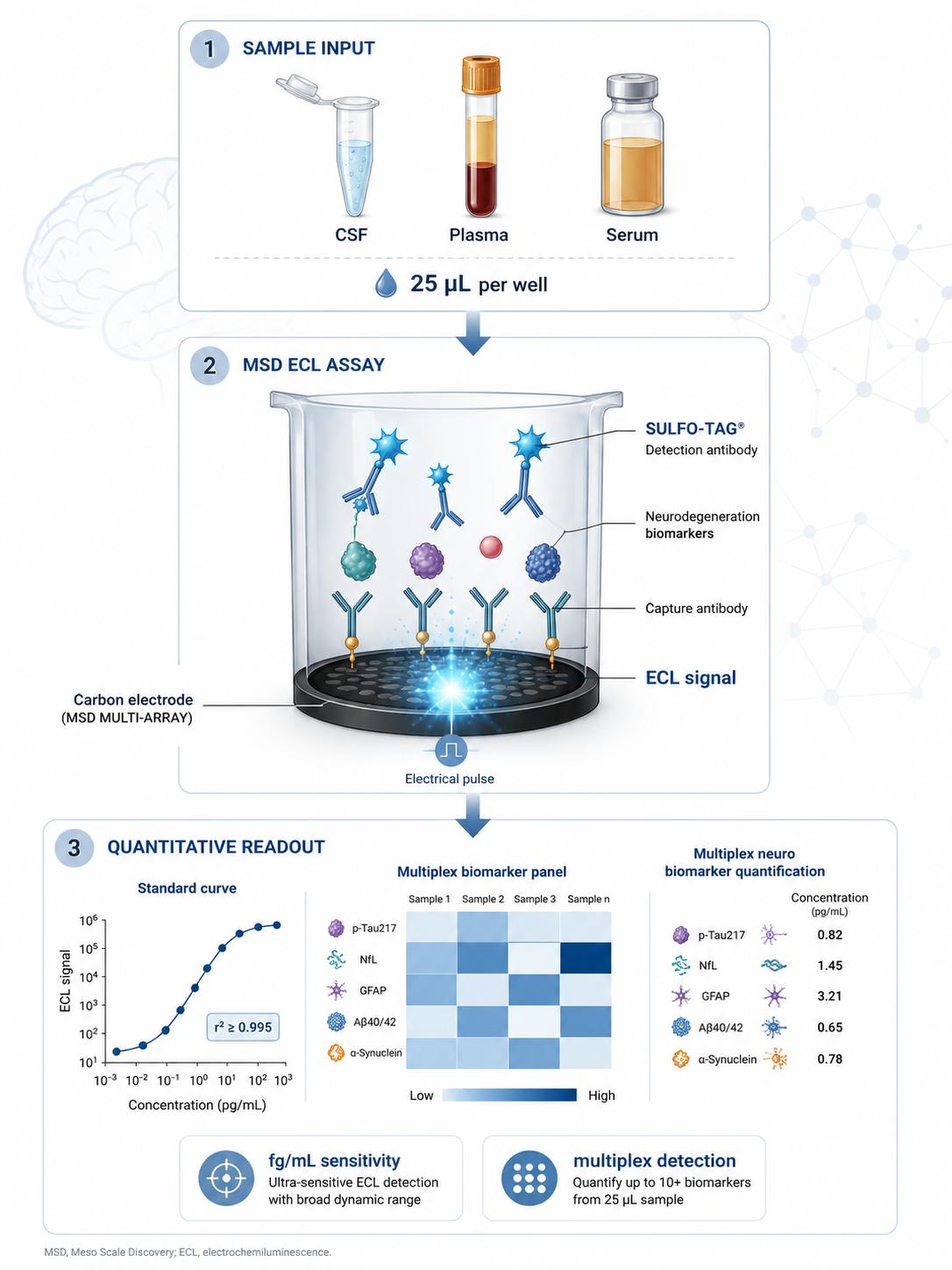
60+ pre-configured MSD panels for metabolic and endocrine research — from focused gut hormone panels to comprehensive metabolic discovery platforms.
| Panel / Service | Analytes | Species | Type |
|---|---|---|---|
| MSD Human Metabolic 2-Plex | Insulin, Leptin | Human | Service / Kit |
| MSD Human Metabolic 3-Plex | GLP-1 (active), Glucagon, Insulin | Human | Service / Kit |
| MSD Human Metabolic 7-Plex (Panel 1) | C-Peptide, GIP (total), GLP-1 (total), Glucagon, Insulin, Leptin, PYY (total) | Human | Service / Kit |
| MSD Human Metabolic 7-Plex (Panel 2) | C-Peptide, GIP (total), GLP-1 (active), Glucagon, Insulin, Leptin, PYY (total) | Human | Service / Kit |
| MSD Human Metabolic 10-Plex Panel 1 | Adiponectin, ApoA1, ApoC3, Clusterin, CRP, DPPIV, NGAL/LCN2, RBP4, SHBG, sTfR-1 | Human | Service / Kit |
| MSD Human Metabolic 10-Plex Panel 2 | BDNF, β-NGF, IL-1β, IL-6, IL-8, IL-10, Insulin, Leptin, MCP-1, TNF-α | Human | Service / Kit |
| MSD Human Metabolic 22-Plex | BAFF, BDNF, β-NGF, C-Peptide, FGF-21, FGF-23, FSH, Ghrelin (active/total), GIP (active/inactive/total), GLP-1 (active/inactive/total), Glucagon, Insulin, Leptin, LH, PP, Proinsulin, PYY (total) | Human | Service / Kit |
| MSD Human Metabolic 87-Plex | 87 analytes: full metabolic hormones + 60+ cytokines, chemokines, growth factors — comprehensive metabolic-immune discovery platform | Human | Service / Kit |
| MSD Human Obesity 5-Plex | BDNF, FGF-21, Ghrelin (total), Glucagon, Leptin | Human | Service / Kit |
| MSD Human Obesity 7-Plex | C-Peptide, FGF-23, Ghrelin (total), GLP-1 (total), Insulin, Leptin, PYY (total) | Human | Service / Kit |
| MSD Human Obesity 10-Plex | BDNF, β-NGF, IL-1β, IL-6, IL-8, IL-10, Insulin, Leptin, MCP-1, TNF-α | Human | Service / Kit |
| MSD Mouse Metabolic 2–13 Plex | Configurable: Insulin, Glucagon, GLP-1, Leptin, C-Peptide, PYY, Ghrelin, FGF-21, BDNF, BAFF — 2 to 13 analytes | Mouse | Service / Kit |
| MSD Mouse Metabolic 58-Plex | 58 analytes: metabolic hormones + 45 cytokines/chemokines for comprehensive metabolic-immune profiling | Mouse | Service / Kit |
| MSD Rat Metabolic 2–12 Plex | Configurable: Insulin, Glucagon, GLP-1, Leptin, C-Peptide, PYY, Ghrelin, FGF-21, BDNF — 2 to 12 analytes | Rat | Service / Kit |
| MSD NHP Metabolic 6-Plex | C-Peptide, GIP (active), GLP-1 (active), Glucagon, Insulin, PP | NHP | Service / Kit |
Panel availability confirmed during project consultation. All panels require protease inhibitor-stabilized blood collection for gut hormone analytes (GLP-1, glucagon, GIP, ghrelin, PYY). Collection protocols and pre-loaded inhibitor tubes provided. All services are for research use only.
Why metabolic hormone quantification requires specialized sample handling — and how our protocols address each analyte's stability requirements.
GLP-1 is cleaved by DPP-IV with an ex vivo half-life of ~1–2 minutes. Glucagon is degraded by multiple plasma proteases. Standard EDTA collection without inhibitors produces falsely low or undetectable levels. Our collection tubes are pre-loaded with DPP-IV inhibitor, aprotinin, and other protease inhibitors per MSD manufacturer specifications — provided to all study sites with detailed collection SOPs.
GLP-1 exists as active (7-36 amide, 7-37) and inactive (9-36 amide) forms. GIP has active and inactive species. Ghrelin requires octanoylation at Ser3 for receptor activation. Total assays capture all forms; active assays use isoform-specific antibodies. Choosing the correct assay for your research question — incretin effect vs. total secretion, for example — is critical to data interpretation.
Blood must be chilled immediately after collection and centrifuged at 4°C within 30 minutes. Plasma should be aliquoted into single-use polypropylene cryovials and frozen at −80°C. Delayed processing, room-temperature handling, or repeated freeze-thaw cycles will degrade gut hormones even in the presence of protease inhibitors. We provide time-and-temperature documentation forms for each collection event.
These pre-analytical requirements are not optional — they are the difference between detecting a real biological change in GLP-1 secretion and measuring the rate of ex vivo degradation. Our metabolic assay service includes pre-loaded inhibitor tubes, collection SOPs, and pre-analytical QC review for every sample.
Consult on your metabolic research objectives, species, and analytes of interest. We advise on active vs. total isoform selection, panel configuration, and collection tube requirements.
Protease inhibitor-loaded collection tubes, detailed collection SOPs, and time/temperature documentation forms shipped to all study sites before sample collection begins.
Samples accessioned with pre-analytical QC review: collection-to-centrifugation time, visual inspection for hemolysis, freeze-thaw history verification.
Assays on MESO QuickPlex SQ 120 or SECTOR S 600. Each plate: multi-analyte 8-point standard curves, three-level QC controls in duplicate, blank wells. All runs follow documented protocols.
Comprehensive report: analyte concentrations, QC metrics, standard curve plots, raw ECL data, and methods summary. Pre-analytical QC flags documented alongside quantitative results.
Required for all gut hormone panels. Blood collected into pre-chilled tubes containing DPP-IV inhibitor and aprotinin. Gently invert 8–10 times. Centrifuge immediately at 1,500×g for 10 min at 4°C. Transfer plasma to polypropylene cryovials. Freeze at −80°C. Timing is critical: collection-to-freezing should be completed within 30 minutes.
Acceptable for metabolic protein panels that do not include gut hormones (e.g., adiponectin, CRP, RBP4, SHBG). Collect in SST tubes, allow 30 min clotting at RT, centrifuge at 1,500×g for 10 min at 4°C. Not acceptable for GLP-1, glucagon, GIP, ghrelin, or PYY — these require protease inhibitor plasma.
For OGTT, meal tolerance tests, or clamp studies requiring multiple timepoints: pre-label cryovials for each timepoint, keep tubes on wet ice before and after collection, and document exact collection and centrifugation times. Volume-limited mouse studies: 25 µL per well enables comprehensive hormone profiling from serial samples.
Shipping: Samples on dry ice via overnight courier. We provide pre-loaded inhibitor collection tubes, cryovials, labels, and temperature loggers. Critical: do not allow samples to thaw during shipping — gut hormones degrade rapidly even with inhibitors if temperature rises above −20°C. Include a temperature indicator with each shipment.
Analyte concentrations with per-analyte QC metrics (intra/inter-plate CV), standard curve parameters, LOD/LLOQ values. Pre-analytical QC flags documented alongside results. Excel and PDF.
Raw ECL signal values, per-analyte standard curve plots, QC trend charts, plate layout maps. Compatible with R, Python, GraphPad Prism for independent analysis.
Detailed protocol including collection tube specifications, protease inhibitor composition, assay conditions, and QC acceptance criteria — formatted for manuscript Methods sections.
GLP-1, glucagon, GIP, ghrelin, and PYY are peptide hormones with extremely short ex vivo half-lives due to rapid degradation by DPP-IV and other plasma proteases. Without DPP-IV inhibitor and aprotinin in the collection tube, GLP-1 degrades with a half-life of ~1–2 minutes — meaning a 10-minute delay between blood draw and centrifugation can result in >90% loss of detectable active GLP-1. This is not an assay sensitivity issue — it is a pre-analytical issue. Our collection tubes are pre-loaded with the inhibitor cocktail specified by MSD manufacturer protocols. For studies where inhibitor-loaded tubes cannot be used (e.g., retrospective biobank samples collected without inhibitors), we recommend limiting analysis to relatively stable analytes (insulin, C-peptide, leptin) rather than gut hormones.
The choice depends on your research question. Active GLP-1 (7-36 amide, 7-37) is the biologically active form that engages the GLP-1 receptor — relevant for studies of incretin effect, GLP-1 receptor agonist pharmacology, and DPP-IV inhibitor efficacy. Total GLP-1 captures all forms (active + inactive 9-36 amide) and reflects overall L-cell secretion — more appropriate for studies of nutrient-stimulated secretion, bariatric surgery effects on enteroendocrine function, and conditions where DPP-IV activity may vary between groups. Many programs measure both: active GLP-1 for pharmacodynamic endpoints and total GLP-1 for overall secretory response. Our 7-Plex Panel 2 includes active GLP-1; Panel 1 includes total GLP-1. The 22-Plex includes both.
Yes — MSD's 25 µL per well requirement is a key advantage for rodent metabolic research. A single mouse plasma sample (typically 50–150 µL from terminal collection, or 10–25 µL per serial timepoint) can be analyzed on a 7-plex metabolic hormone panel. For serial sampling during glucose tolerance tests or meal challenges, we recommend pre-planning the minimum plasma volume per timepoint with our scientific team during study design. Mouse-specific panels (2-plex through 58-plex) are available with species-validated antibody pairs.
Traditional metabolic hormone measurement has relied on individual RIAs or ELISAs — one analyte per well, consuming 50–100 µL each. To measure insulin, glucagon, active GLP-1, and leptin by RIA requires four separate assays totaling 200–400 µL of plasma — often more than a single mouse sample provides. MSD multiplexing measures all four from 25 µL. Beyond volume, MSD offers wider dynamic range (insulin from fasting ~50 pg/mL to postprandial >5,000 pg/mL in one well without dilution), no radioactive waste (unlike RIA), and faster readout (~70 seconds/plate vs. hours for ELISA). For preclinical metabolic research — particularly rodent studies — the volume advantage alone is transformative.
Every metabolic panel assay includes: (1) 8-point standard curve with R² and back-fit accuracy per analyte; (2) three-level QC samples run in duplicate on each plate; (3) intra-plate CV per analyte; (4) inter-plate CV for multi-plate studies; (5) LOD and LLOQ per analyte; (6) raw ECL signal data; (7) pre-analytical QC documentation (collection-to-freeze time, visual hemolysis assessment, freeze-thaw count). For gut hormone analytes, pre-analytical QC is as important as analytical QC — we flag samples with processing delays, hemolysis, or freeze-thaw concerns rather than silently reporting potentially unreliable values.
Online Inquiry
×