
Serum and plasma should be treated as different cytokine study matrices, not interchangeable labels for blood-derived samples. The matrix decision changes what can be compared across a cohort because clotting, anticoagulant choice, platelet-related effects, processing delay, and assay behavior may alter the measured concentration of individual cytokines and related immune proteins.
The practical question is not whether one matrix is universally superior. It is whether the chosen matrix, tube, handling route, and panel support the scientific comparison. A well-designed serum cohort and a well-designed plasma cohort can both be useful; a mixed cohort with unrecorded matrix differences is difficult to interpret.
Key takeaways
- Select serum or one defined plasma anticoagulant before cohort collection and keep it consistent within direct comparisons.
- Do not merge serum, EDTA plasma, citrate plasma, and heparin plasma into one unqualified cytokine dataset.
- Treat clotting, platelet-associated effects, processing time, and freeze–thaw history as metadata that shape comparability.
- Use a matched feasibility subset when archived material or a new panel makes matrix behavior uncertain.
Why Serum and Plasma Produce Different Cytokine Results
Serum is collected after clot formation, whereas plasma is collected from anticoagulated blood. Those routes do not preserve the same soluble environment. The resulting difference can matter for cytokines, chemokines, growth factors, and platelet-associated proteins, particularly when the study relies on small changes or combines multiple collection sources.
In a multiplex study of matched serum and plasma samples, numerous analytes differed between serum and plasma, and selected plasma measurements also differed by anticoagulant (Biancotto et al., 2012). A larger immune-protein study likewise found that only a subset of measured markers showed similar expression profiles across serum, EDTA plasma, and heparin plasma (Jager et al., 2018). These findings support a simple design rule: matrix consistency is part of the cohort definition.
For blood-derived research samples, serum and plasma cytokine assay services can be planned around the available tube type, intended analytes, sample volume, and comparison groups. The service discussion should identify the actual matrix instead of calling all blood-derived specimens “serum/plasma.”
Serum vs Plasma Cytokine Study Design: Start with the Comparison You Need
| Research situation | Preferred design response | What not to assume |
|---|---|---|
| One prospective cohort | Select one matrix and one tube type before collection; standardize processing and storage. | That another anticoagulant will yield directly comparable values. |
| Archived material in one matrix | Use the available matrix consistently and choose a panel with a matrix-aware feasibility review. | That a new serum or plasma collection is needed merely for uniformity. |
| Mixed serum and plasma archive | Stratify by matrix or use a matched feasibility subset to determine whether a restricted comparison is possible. | That a global conversion factor will correct every analyte. |
| Follow-up cohort | Preserve the original matrix and handling logic when longitudinal comparability is required. | That an alternate tube is a harmless logistical substitution. |
A matrix choice should be driven by the research question and the material that can be collected consistently. For example, a prospective cohort may prioritize one validated anticoagulant workflow for compatibility with planned analyses. An archive study may prioritize a consistent existing matrix over introducing a new collection route that cannot be compared with the historical samples.
If the study asks about relative differences within one tightly standardized serum collection workflow, use serum consistently. If it asks about a cohort collected under one plasma protocol, retain that plasma type and its anticoagulant as part of every result record. If materials are mixed, do not use the matrix label as an adjustment variable until a matrix-aware feasibility assessment supports the intended comparison.
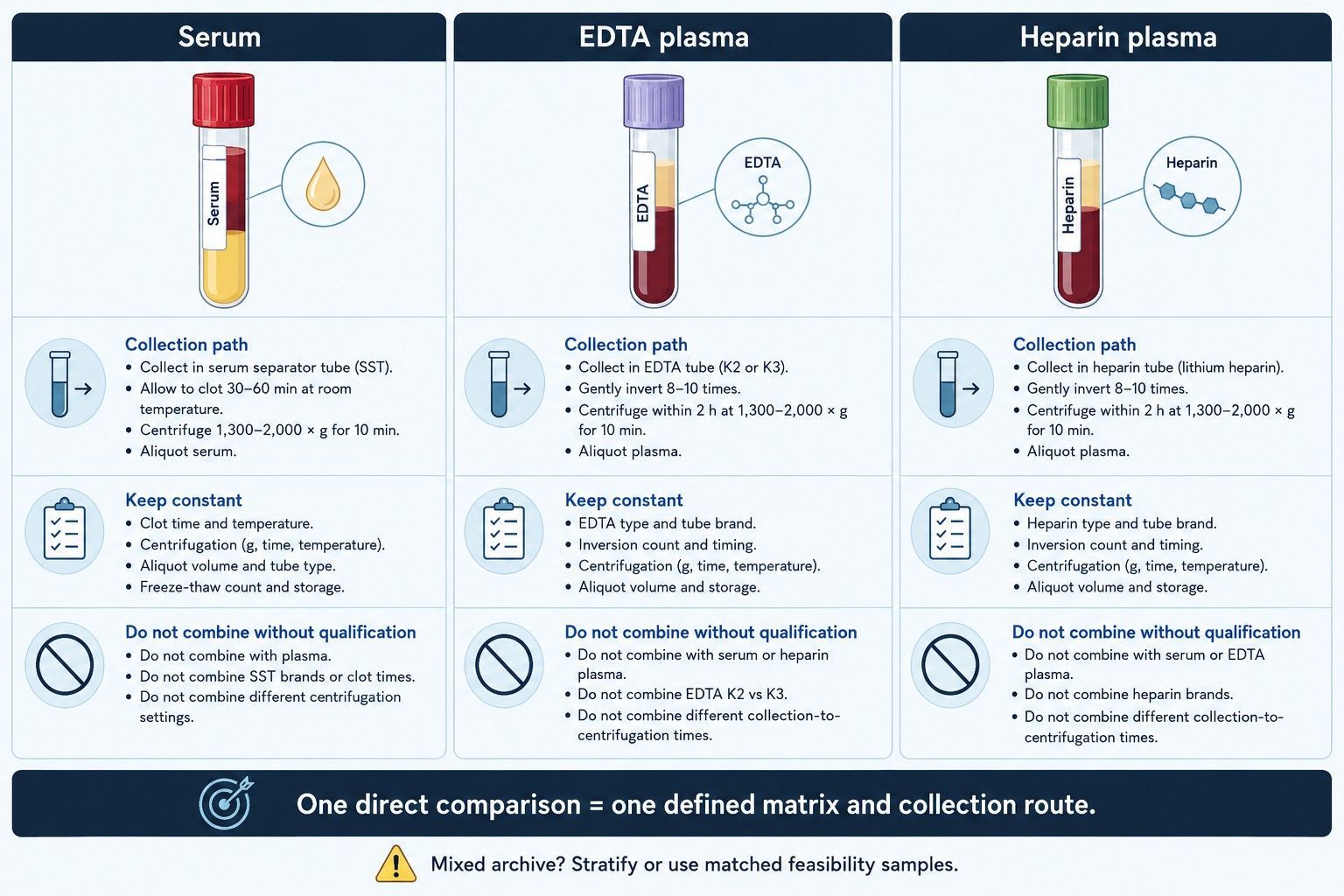 Matrix selection begins at collection and determines what a cytokine cohort can compare.
Anticoagulants and Multiplex Cytokine Panel Compatibility
Plasma is not one uniform material. EDTA, citrate, and heparin are different anticoagulant environments, and their impact may vary by analyte and assay. The correct choice should be made once for the cohort and retained through collection, because a panel’s standard curve performance does not guarantee that every analyte behaves identically in every plasma type.
In matched specimens assessed on a 72-analyte multiplex panel, several analytes differed among heparin, citrate, and EDTA plasma, while other analytes were similar (Biancotto et al., 2012). Therefore, “plasma” is insufficient metadata for a high-value cytokine study. The tube type and anticoagulant should appear in the sample manifest and in any published or delivered result table.
A focused matrix feasibility assessment should examine
- Detectability of the decision-critical cytokines in the actual serum or plasma matrix.
- Dilution behavior and recovery where the matrix or panel is nonstandard.
- Whether concentrations cluster by anticoagulant or collection route in matched materials.
- The expected distribution of values relative to the panel’s useful measurement range.
- Whether the proposed data presentation retains original matrix and processing metadata.
The purpose is not to declare one anticoagulant universally best. It is to verify that the selected anticoagulant and panel support the intended interpretation. If a critical analyte behaves differently across the available matrices, separate those matrices, select a more suitable analytical approach, or narrow the claim rather than treating the differences as noise.
For broader panel selection and sample review, custom cytokine panel design can connect anticipated concentration range, target biology, and the actual collection matrix. This keeps the service link aligned with a decision point instead of placing it only at the end of the article.
Platelet-Related Effects and Blood Processing Metadata
Clotting and platelet activation can affect the concentration of platelet-associated proteins and other analytes in a way that matters for cytokine-panel interpretation. The relevant impact is analyte- and workflow-dependent, so a general statement that serum is “higher” or plasma is “cleaner” is not a sufficient design rule.
Record collection-to-processing interval, centrifugation and aliquoting approach, visible hemolysis or other sample-quality observations, and freeze–thaw history. These variables help distinguish a real cohort pattern from a collection artifact. They also make it possible to identify whether a subgroup was processed under a different route.
In an evaluation of archived specimens, the optimal sample medium varied across analytes because detectability and dynamic range differed by matrix (Brøndum et al., 2016). The practical response is to decide which analytes are critical before the full cohort is run, then confirm that their behavior in the chosen matrix supports the research question.
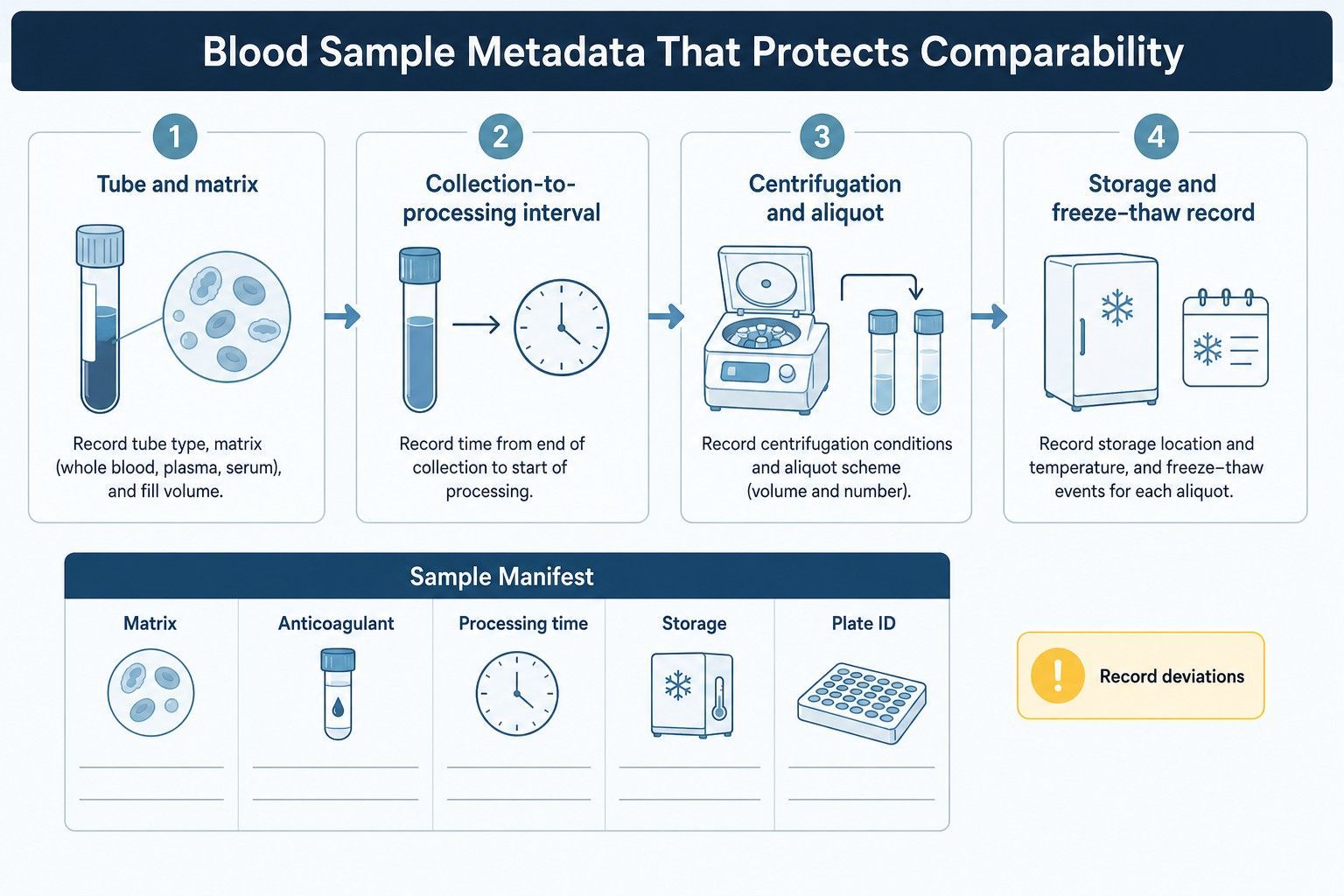 Serum and plasma require matrix-specific collection records and a preplanned comparability rule.
How to Keep Multi-Cohort Cytokine Data Comparable
Comparability begins by avoiding hidden matrix changes. Keep serum with serum and one defined plasma type with that same plasma type for direct analysis. Balance other sources of variation, such as collection site, storage age, and analytical run, across the research groups where possible. A bridge control can monitor the analytical side of a multi-batch programme but cannot convert one biological matrix into another.
When a study contains more than one valid matrix, report results in matrix-specific strata unless a matched assessment justifies a narrower cross-matrix conclusion for specified analytes. Keep the raw concentration, matrix, anticoagulant, processing metadata, dilution, and result qualifier together. This is more informative than a single transformed value that hides how the sample was collected.
For the operational details of repeated controls across analytical runs, refer to the cytokine batch-effects and bridge-controls guide. It complements this matrix-selection guide by addressing technical comparability after sample collection has been standardized.
Archived Serum and Plasma: How to Set a Defensible Comparability Boundary
Archive studies frequently contain valuable material collected under more than one historical protocol. Begin with an inventory rather than a single combined spreadsheet. For every sample, identify the reported matrix, tube or anticoagulant where known, collection source, processing interval, storage duration, freeze–thaw history, and available volume. This inventory reveals whether the cohort can support a uniform primary analysis or whether it should be divided into matrix-defined strata.
A matched feasibility subset can be useful when material from the same donor or model is available in more than one matrix. It can show which decision-critical analytes remain directionally comparable under the planned panel and which should not be interpreted across matrices. It cannot establish that every other analyte or every historical sample is interchangeable. Limit the eventual claim to the evidence the matched subset provides.
When the archive contains one dominant matrix and a small minority of another, the most interpretable primary analysis may be restricted to the dominant matrix, with the minority retained for a descriptive or separate exploratory analysis. This is often preferable to expanding sample count at the expense of a clearly defined measurement context. The final report should state the boundary openly: which samples contribute to the direct comparison and which are displayed separately because their collection route differs.
Common Serum and Plasma Cytokine Study Mistakes
- Calling all blood-derived materials “serum/plasma” without recording the actual matrix and tube.
- Combining serum and plasma values into one direct analysis without a matrix rationale.
- Changing anticoagulant between collection sites or longitudinal timepoints.
- Treating platelet-related analyte shifts as universal rather than assay- and workflow-specific.
- Using a buffer blank as a substitute for matrix-aware feasibility work.
- Trying to repair mixed archive materials with an unvalidated universal correction factor.
Planning a Serum or Plasma Cytokine Profiling Project
Provide the matrix, tube manufacturer or anticoagulant, collection and processing interval, planned centrifugation and aliquoting route, storage condition, freeze–thaw history, sample count, sample volume, key cytokines, and whether the cohort includes legacy material. These details define what a feasibility study should test and whether a multiplex panel can support the requested comparison.
Creative Proteomics can support serum and plasma cytokine profiling with matrix-aware panel selection, feasibility review, cohort stratification logic, and a report that retains collection metadata next to each analytical result. This makes the final dataset useful for biological interpretation and for a later focused follow-up study.
Serum and Plasma Cytokine Study Design Checklist
Before collection or submission, lock the sample matrix, anticoagulant if plasma is used, tube type, processing interval, centrifugation and aliquot rule, storage plan, permitted freeze–thaw history, primary analytes, and comparability boundary. For archive studies, create a matrix inventory before choosing the final panel.
Use serum or plasma when it is the consistent matrix that matches the study’s collection reality and analyte needs. Do not choose a matrix by reputation alone, and do not compare matrices as though the collection route had no effect. In cytokine research, the sample matrix is part of the measurement.
Frequently Asked Questions
Is serum or plasma better for multiplex cytokine profiling?
Neither is universally better. Select the matrix that matches the biological question, available archive, panel behavior, and future cohort plan, then keep it consistent within direct comparisons.
Can serum and plasma be combined in one cytokine dataset?
Do not combine them as though they were interchangeable. Use a matrix-comparison study only when it is separately designed and interpreted; otherwise analyse serum and plasma in distinct strata.
Which plasma anticoagulant should I use for a cytokine study?
Choose one anticoagulant based on the intended analytes, assay compatibility, and available collection workflow, then maintain it for the full comparison. Different anticoagulants can change measured concentrations for some cytokines and related proteins.
Why can platelet-related analytes differ between serum and plasma?
Clotting and sample processing can change the release or distribution of platelet-associated factors. The direction and magnitude are analyte- and workflow-dependent, so this should be assessed in the selected matrix rather than assumed.
Should I use archived serum and plasma together if they are all that is available?
Only after acknowledging the matrix difference and evaluating whether the study can be stratified, restricted, or supported by a matched feasibility subset. A post hoc mathematical conversion is rarely a reliable substitute for matched collection.
What should be recorded with each blood-derived cytokine sample?
Record matrix, tube and anticoagulant, collection-to-processing interval, centrifugation and aliquoting rule, storage, freeze–thaw history, and any visible quality observations. These details define cohort comparability.
References:
- Biancotto A, et al. Effect of anticoagulants on multiplexed measurement of cytokine/chemokines in healthy subjects. Cytokine. 2012;60:438–446.
- Jager W, et al. Effect of anticoagulants on 162 circulating immune related proteins in healthy subjects. Cytokine. 2018;106:59–67.
- Rosenberg-Hasson Y, et al. Effects of serum and plasma matrices on multiplex immunoassays. Immunologic Research. 2014;58:224–233.
- Parkitny L, et al. Multiplex cytokine concentration measurement: how much do the medium and handling matter? Mediators of Inflammation. 2013;2013:890706.
- Brøndum L, et al. An evaluation of multiplex bead-based analysis of cytokines and soluble proteins in archived lithium heparin plasma, EDTA plasma and serum samples. Scandinavian Journal of Clinical and Laboratory Investigation. 2016;76:601–611.