
PBMC and whole blood cytokine release assays answer related but different research questions. PBMC cultures provide a defined mononuclear-cell model that can be normalized and paired with cellular readouts, whereas whole blood retains a broader blood-cell and soluble-factor environment. The right choice follows the biological system that the project needs to represent.
Both formats can generate informative multiplex cytokine data, but neither format is a generic replacement for the other. Cell isolation, anticoagulant choice, time from collection to stimulation, plating density, stimulation vessel, incubation window, and donor variability can materially change the observed response. The study should define these variables before panel selection.
Key takeaways
- Choose PBMC when a controlled mononuclear-cell model and cell-associated denominator are central to the question.
- Choose whole blood when the intact cellular and soluble blood environment is part of the research model.
- Plan donor, control, timepoint, and matrix rules together; variation cannot be removed by analysis alone.
- Retain raw cytokine concentration plus the metadata needed to interpret cell number, viability, anticoagulant, and exposure timing.
PBMC vs Whole Blood Cytokine Release: What Each Model Captures
PBMC preparations enrich lymphocytes and monocytes while excluding most granulocytes, platelets, erythrocytes, and the native plasma environment. This creates a more defined cellular system and makes it practical to normalize results to viable PBMC input or endpoint cell number. It can also support related flow-cytometry or cellular phenotyping work from matched cultures.
Whole blood retains a broader cellular composition and plasma-associated environment. This may be appropriate when the question concerns cytokine release in a more integrated blood context, but it also introduces variables that cannot be separated from the observed response: anticoagulant, hematocrit, cell composition, plasma factors, and collection-to-stimulation delay.
| Decision criterion | PBMC assay | Whole blood assay |
|---|---|---|
| Primary biological model | Defined mononuclear-cell response. | Broader blood-cell and soluble-factor response. |
| Cell normalization | Usually practical with viable-cell or PBMC input measurement. | Requires careful accounting for blood volume and cellular composition. |
| Preparation variables | Isolation method, recovery, viability, and culture medium. | Anticoagulant, delay, dilution, and whole-blood composition. |
| Best use case | Mechanistic cellular questions and matched cell-associated outputs. | Research questions that require the native blood environment. |
| Comparison rule | Do not assume results represent whole blood. | Do not assume results represent isolated PBMC behavior. |
In matched experiments, PBMC and whole blood can show agreement for some cytokines and different responses for others. A study comparing the two systems reported assay-dependent differences across cytokines, which reflects the fact that the models do not contain the same cells or milieu (Santos et al., 2013). The relevant conclusion is conditional: if the hypothesis is cell-intrinsic mononuclear response, PBMC may be the appropriate model; if the hypothesis depends on a broader blood environment, whole blood may be more appropriate.
For a defined mononuclear-cell project, PBMC cytokine assays can be scoped around donor material, stimulation logic, viability measurements, and a fit-for-purpose multiplex panel. The service discussion should start with the intended biological model, not with a request to run the same panel in every available sample format.
Donor Variability Is a Design Variable, Not an Analytical Error
Donor-derived cytokine release can vary both between experimental units and across repeated collections from the same unit. In one study of TNF-alpha release, high intra- and inter-individual variability was observed in both PBMC and whole-blood models and was not eliminated simply by correcting for cell number (Bakiyeva et al., 2005). This does not make the formats unusable. It means that the study must distinguish a biological donor effect from a test-condition effect.
Design around the intended comparison
- For a paired design, expose matched aliquots from the same donor to test and control conditions.
- For a comparative donor study, predefine whether donor is a blocking factor, random effect, or primary source of biological variation.
- Record collection time, sample age, anticoagulant, PBMC recovery, viability, and any deviation from the planned stimulation window.
- Use sufficient independent donors for the expected biological heterogeneity; justify the number using the primary endpoint rather than panel size alone.
Avoid pooling donor material merely to reduce visible variation unless the pooled material is explicitly intended as a technical control. Pooling can conceal the distribution of response and remove the very biological heterogeneity the study needs to understand. A pooled reference is useful as a repeated bridge material, but it is not a substitute for independent donor-level observations.
If the project asks whether a compound changes cytokine release across a diverse donor set, use an experimental design that preserves donor identity and matches test versus control within donor. If it asks whether a defined cell system responds to a stimulus, use PBMC with a prespecified cell-input and viability rule. If it asks about response in the broader blood environment, use whole blood with a documented anticoagulant and handling plan.
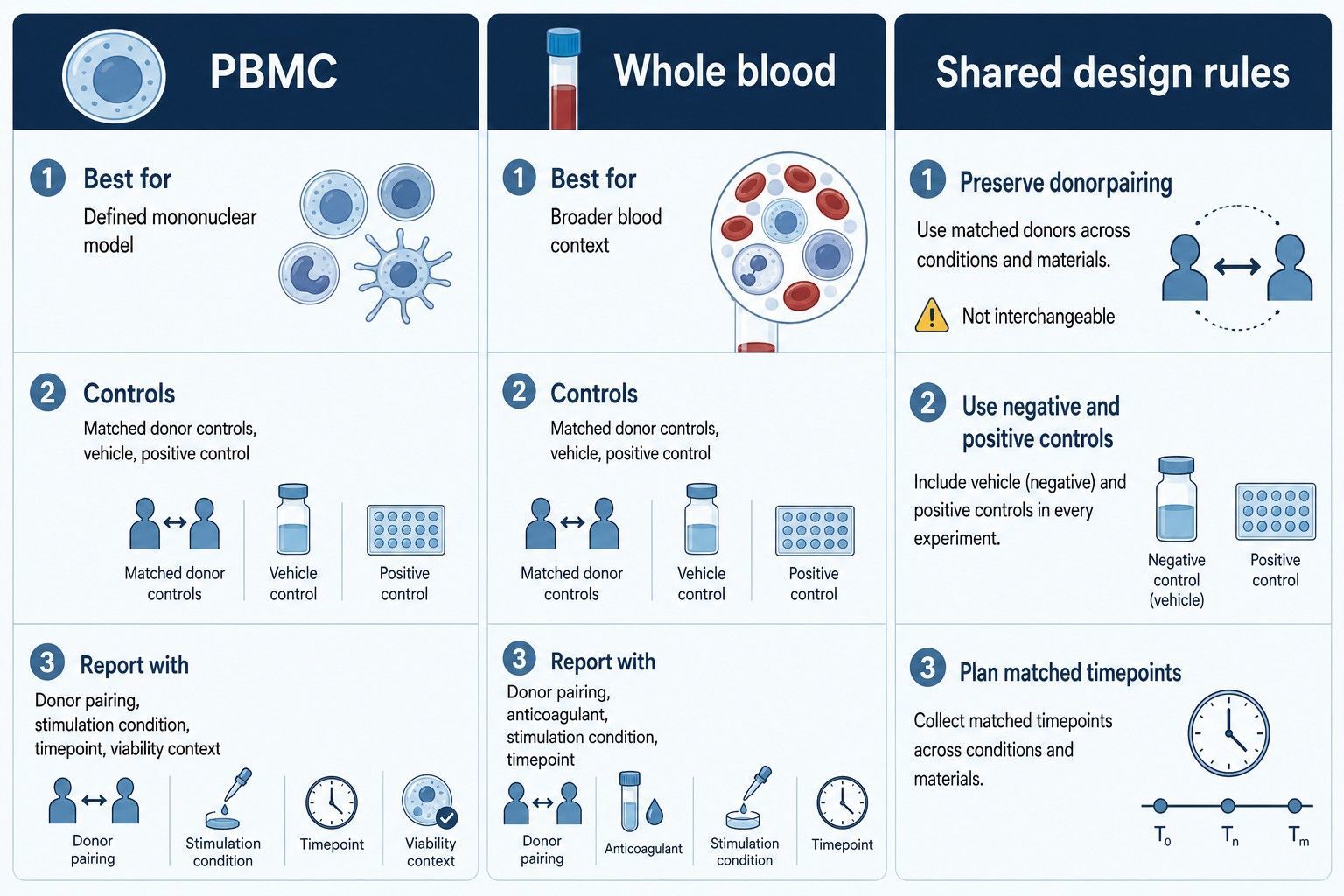 PBMC and whole blood assays preserve different components of the immune response model.
Stimulation Controls for PBMC and Whole Blood Cytokine Release Assays
A control strategy should separate biological responsiveness, vehicle effect, background, and technical performance. The exact stimulus is study-specific, but the logic should be the same across formats. A negative control establishes baseline output in the defined matrix. A vehicle control controls for the test formulation. A positive biological control demonstrates that the model can produce a response. A matrix or assay control supports the analytical run.
| Control | Question it answers | Common misuse to avoid |
|---|---|---|
| Unstimulated or matched negative control | What is the baseline output in this cell system and medium? | Using a different medium or collection interval than the test condition. |
| Vehicle control | Is the observed effect attributable to the test material rather than formulation? | Omitting it when solvent or carrier differs. |
| Positive biological control | Can this preparation produce an expected response? | Treating it as evidence that every analyte is in range. |
| Viability or cell-count readout | Did changed output occur with changed cell recovery or survival? | Normalizing only after a cytotoxic effect becomes apparent. |
| Matrix-matched blank | Does medium or assay matrix contribute background? | Using buffer alone as the only blank for culture supernatants. |
Whole blood cytokine studies are especially sensitive to pre-analytical decisions. In an ex vivo stimulation assay, time and duration of stimulation, temperature control, vessel properties, anticoagulant, and several day-to-day sources of variation all contributed to performance (Ray et al., 2005). The design implication is practical: standardize the controllable variables and record the unavoidable ones.
For projects that use many mediators across several stimuli, custom cytokine panel design can align control materials and dilution strategy with the decision-critical cytokines. A very broad panel is not useful if the primary cytokines are not interpretable under the selected culture conditions.
How to Select PBMC and Whole Blood Cytokine Release Timepoints
Cytokine release is kinetic, and the relevant release window differs among mediators and stimulation models. A single terminal collection may be sufficient for a standardized accumulated-output question, but it cannot describe whether a low concentration reflects delayed induction, early peak and decline, or failure to respond.
A focused time-course feasibility experiment should bracket the anticipated response rather than assume one universal endpoint. Include the primary cytokines, the planned matrix, the intended donor handling, and the same control logic as the production study. The purpose is to choose a defensible collection window and determine whether a single timepoint can support the planned claim.
If the project needs an early activation signal and later regulation, include multiple biologically justified windows. If it needs a comparative rank order after standardized exposure, use one fixed interval with matched handling. If response timing itself is uncertain, use a pilot to choose the production schedule rather than relying on an endpoint reported for another stimulus or cell system.
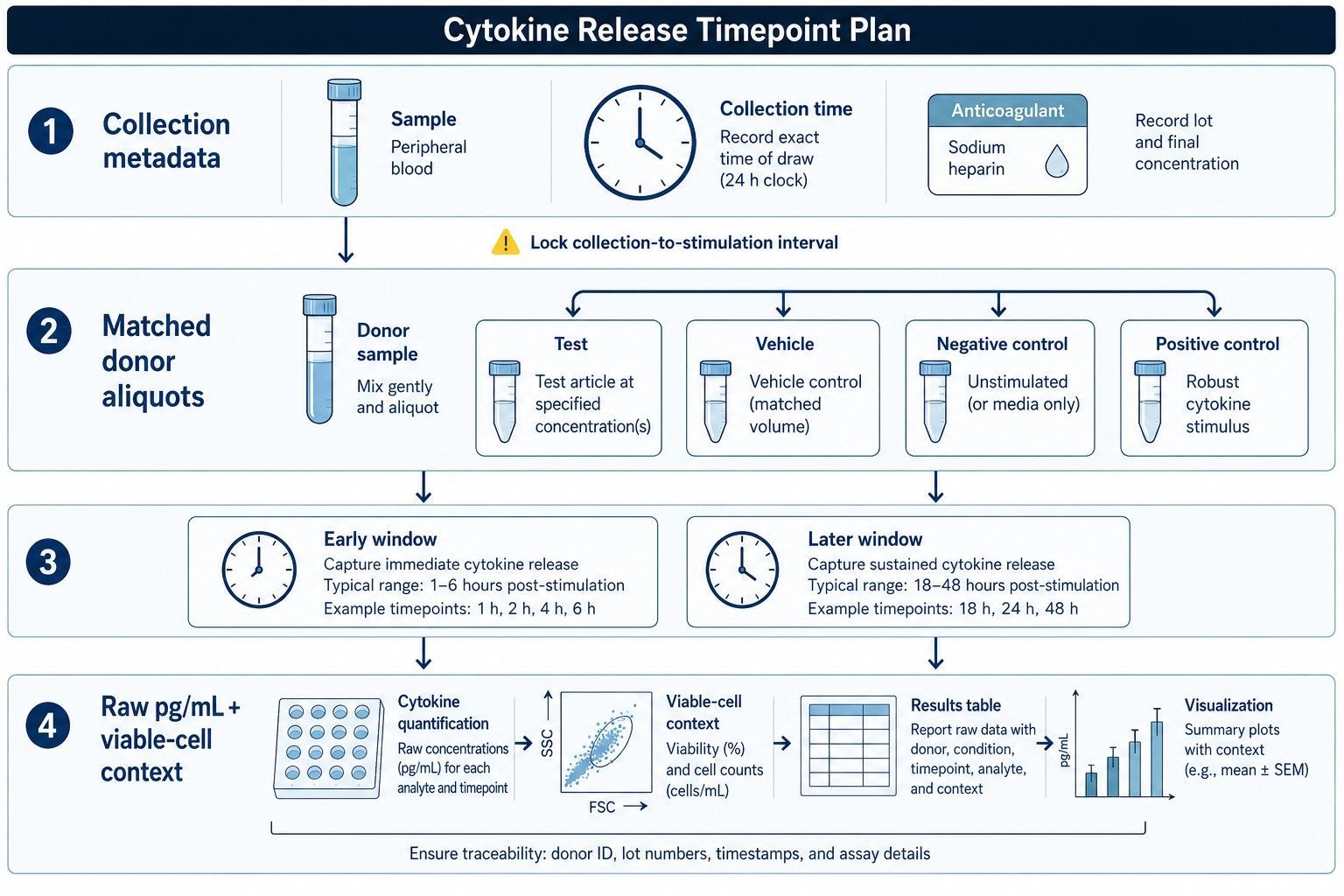 Timepoint selection should match the expected cytokine kinetics and the biological claim.
PBMC and Whole Blood Multiplex Cytokine Data: Reporting and Interpretation
Retain the direct assay result in pg/mL, then add a denominator only when it is measured consistently and supports a defined claim. PBMC experiments may also report amount per viable cells or per defined input cell number. Whole-blood experiments may report concentration in the standardized culture volume, accompanied by blood volume, anticoagulant, dilution, and cell-count metadata where relevant.
Do not combine PBMC and whole-blood values in one direct quantitative comparison simply because the same cytokine panel was used. They represent different experimental matrices. Present the results in model-specific strata or use matched exploratory plots that clearly label the model and do not imply interchangeability.
When concentration ranges differ across analytes, use an analytical plan that preserves decision-critical markers. A feasibility set can indicate whether one dilution is adequate or whether split panels are needed. The panel dilution and split strategy guide provides related decision support for that analytical problem.
Feasibility Readout Before a Donor-Scale Cytokine Release Study
A feasibility readout should answer the uncertainties that would otherwise compromise the donor-scale experiment: whether selected controls produce a measurable response, whether the planned collection interval captures the relevant mediator window, whether decision-critical cytokines are within a useful measurement range, and whether viability or cell-recovery information is obtainable from the same experimental unit. It should use representative donor material and the exact matrix that the production study will use.
Do not use a small feasibility set to claim population-level donor effects. Its role is to finalize the model, control, timepoint, and reporting rules. Once these are locked, the donor-scale study can estimate biological variation with a structure that does not change in response to early data.
Common PBMC and Whole Blood Cytokine Release Assay Mistakes
- Selecting PBMC or whole blood based on convenience rather than the biological model.
- Calling a whole-blood result a PBMC response, or the reverse.
- Comparing donors without preserving matched test and control aliquots.
- Using a positive control without a matched negative or vehicle control.
- Ignoring time from collection to stimulation and anticoagulant in whole-blood studies.
- Reporting normalized PBMC values without retaining raw concentration, viable-cell information, and the denominator rule.
Planning a PBMC or Whole Blood Cytokine Release Study
To scope a study, provide the source material, species, experimental question, intended model, donor structure, collection and anticoagulant rules, expected time from collection to stimulation, culture matrix, test and control conditions, proposed collection windows, viable-cell measurement, sample volume, and key cytokines. These inputs determine whether PBMC, whole blood, or a matched complementary design will answer the question.
Creative Proteomics can support multiplex cytokine profiling for PBMC-based research studies and other donor-derived matrices with fit-for-purpose panel selection, control mapping, timepoint planning, and data-reporting structure. The desired outcome is a model-appropriate dataset where biological variation is measured, not mistaken for a technical defect.
PBMC and Whole Blood Study Design Checklist
Before collection, document the model rationale, donor pairing, anticoagulant and collection timing, PBMC isolation or whole-blood dilution plan, matrix and medium, control conditions, planned timepoint, viability or input-cell measurement, analytical batch map, and primary reporting unit. Keep this plan with the final result file, because the choice of model defines what a cytokine concentration means.
Choose PBMC for a defined mononuclear-cell question; choose whole blood for a broader blood-context question. When both are scientifically valuable, treat them as complementary arms with their own controls and interpretation boundaries, rather than forcing them into one interchangeable cytokine dataset.
Frequently Asked Questions
When should I choose PBMC instead of whole blood for cytokine release?
Choose PBMC when the question requires a defined mononuclear-cell system, cell-number normalization, or downstream cellular characterization. Choose whole blood when preserving the cellular and soluble blood environment is more important than isolating the PBMC compartment.
Can PBMC and whole blood cytokine results be compared directly?
They should not be treated as interchangeable because the cell composition, plasma environment, anticoagulant, and stimulation context differ. Use them as complementary models only when the study has an explicit rationale and matched controls.
How many donors are needed for a cytokine release study?
The number depends on the expected effect size, donor-to-donor variation, stimulation model, and primary cytokines. Use pilot data or prior matched-donor data to justify the study size rather than relying on one universal donor number.
Why should a cytokine release assay include a positive control?
A positive control confirms that the cellular preparation and analytical readout can generate a response under the planned conditions. It should be selected for the biological system and interpreted separately from the test condition.
Should I normalize PBMC cytokine release to cell number?
When cell recovery, viability, or plating density can differ, retain raw supernatant concentration and add a prespecified cell-associated denominator. Do not use post hoc normalization to rescue a poorly controlled culture system.
How should timepoints be selected for PBMC or whole blood stimulation?
Use timepoints that separate early and later mediator release based on a targeted feasibility experiment. A single endpoint is appropriate only when the study question is explicitly about standardized accumulated output.
References:
- Bakiyeva LT, et al. Inter-individual and intra-individual variability in TNF-alpha production by human peripheral blood cells in vitro. Cytokine. 2005;30:35–42.
- Ray CA, et al. Optimization of analytical and pre-analytical variables associated with an ex vivo cytokine secretion assay. Journal of Pharmaceutical and Biomedical Analysis. 2005;39:756–761.
- Santos AR, et al. A whole blood assay as a simple, broad assessment of cytokines and chemokines to evaluate human immune responses to Mycobacterium tuberculosis antigens. Acta Tropica. 2013;127:75–81.
- Drewry AM, et al. The development of a novel whole blood stimulation assay to measure cytokine release. Shock. 2016;45:490–499.
- Eastwood D, et al. Cytokine release assays for the prediction of therapeutic mAb safety in first-in-man trials. Cytokine. 2015;72:1–7. PMID: 25960173.