
Longitudinal multiplex cytokine studies are interpretable when timepoints, paired samples, and analytical batches are designed as one system. A cytokine value at month, day, or hour does not stand alone: its meaning depends on the biological interval, the sample’s own earlier measurements, and whether the plate design separates time from technical variation.
Repeated-measures cytokine profiling is used when the research question is about change, persistence, recovery, or response trajectory rather than a single cross-sectional difference. Multiplex assays can make these projects efficient, but they do not solve the design problem. An unbalanced collection schedule or a batch layout where every early sample is run before every late sample can create a pattern that cannot be confidently assigned to biology.
Key takeaways
- Build the collection schedule around biological transitions, not a convenient calendar interval.
- Treat the experimental unit as paired across time and retain the complete sample-timepoint map.
- Balance timepoints and study groups across analytical plates so time is not confounded with batch.
- Use a repeated bridge material to monitor technical drift, while preserving biological replicates and original result flags.
Why Longitudinal Cytokine Studies Need a Paired Design
The central strength of a longitudinal design is that each experimental unit can be compared with its own prior state. This reduces the risk that stable between-unit differences dominate a change signal. It also means that collection identity, timepoint identity, and any protocol deviation must remain connected throughout sample preparation, assay, and analysis.
Cytokine concentrations can vary with collection matrix, handling, storage history, and the assay batch in addition to the intended research factor. Studies comparing serum, plasma, and different anticoagulants have demonstrated that matrix selection can change measured concentrations for numerous immune analytes (Biancotto et al., 2012; Rosenberg-Hasson et al., 2014). In a longitudinal setting, consistency of those conditions is part of the study definition.
For broad pathway coverage, Luminex cytokine detection can measure a planned set of cytokines and chemokines from matched aliquots. The platform choice should follow the expected concentration range and sample volume, but the first priority is a sample map that preserves who, when, matrix, storage, and intended comparison.
How to Select Cytokine Study Timepoints That Answer the Biological Question
A timepoint is not useful merely because it is evenly spaced. Each collection should correspond to a biological state the study needs to distinguish: a pre-exposure reference, an early response, an expected peak or transition, a sustained phase, or a recovery state. The necessary timing depends on the model and the mechanism under study.
| Study objective | Timepoint logic | Interpretation boundary |
|---|---|---|
| Short-lived response | Include an early window and at least one later window to distinguish a transient increase from persistence. | Do not infer a peak from one late collection. |
| Sustained inflammatory state | Use a baseline plus intervals aligned to the expected duration of exposure or model progression. | Keep collection windows consistent across groups. |
| Intervention response | Define baseline before exposure and post-exposure intervals that can separate onset from resolution. | Record any deviations in exposure timing. |
| Mechanistic screening | Pilot a limited kinetic set for decision-critical analytes before committing scarce cohort material. | A pilot informs the design; it is not a substitute for the production cohort. |
An early feasibility exercise can reveal whether the primary analytes are undetectable, saturated, or changing outside the proposed interval. It should include representative matrices and a small number of relevant conditions, not an arbitrary high-density sampling schedule. The result is a defensible reason for selecting the final collection map.
If the aim is to compare a fixed accumulated signal, choose one rigorously standardized collection interval. If the aim is to describe dynamics, choose enough timepoints to identify direction and timing, then analyse the observations as a trajectory. If the expected transition is uncertain, perform a focused kinetic pilot before locking the cohort calendar.
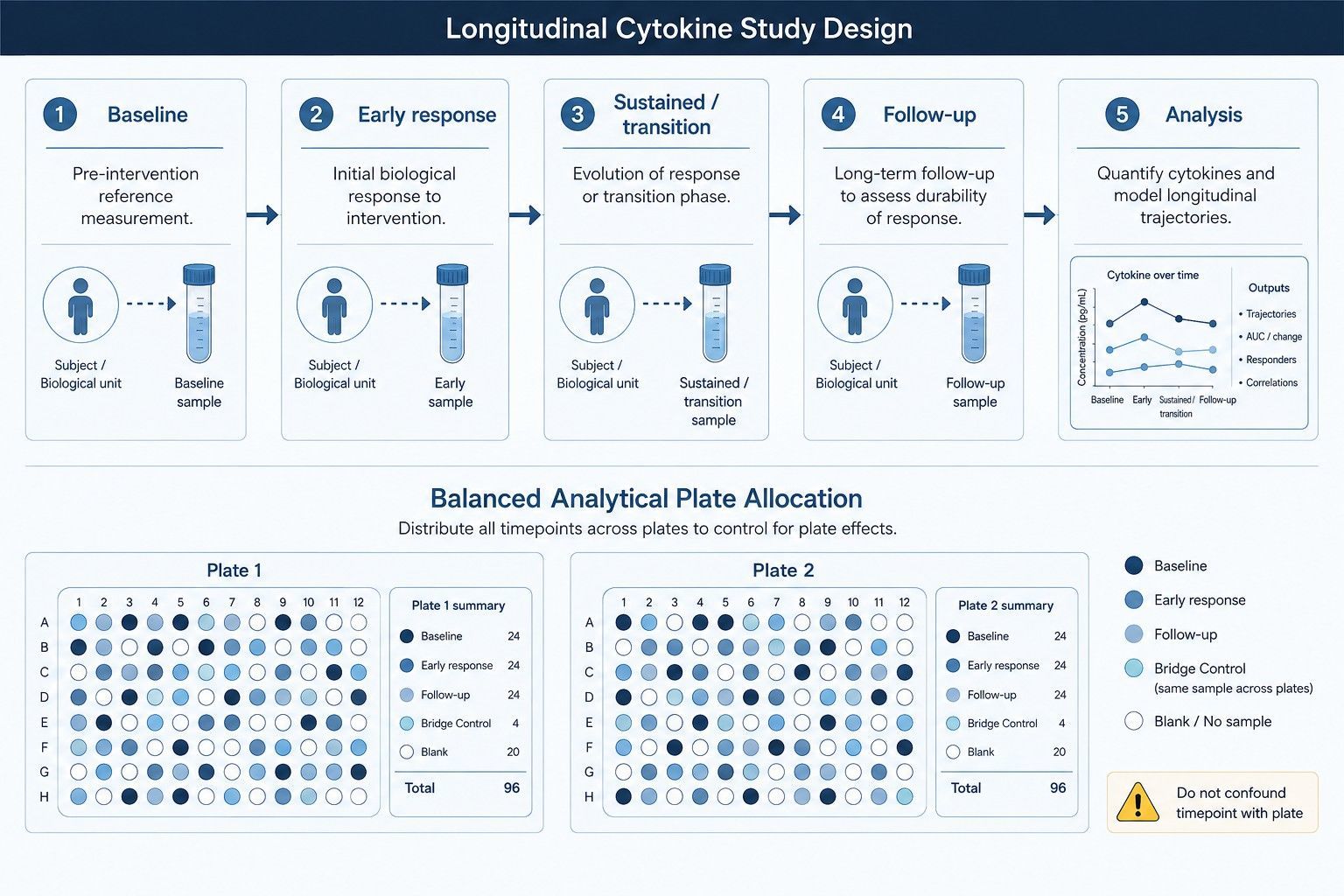 A longitudinal cytokine study requires a connected map from biological timepoint to paired analytical placement.
Repeated Measures, Baseline Values, and Change Metrics
Raw cytokine concentration remains the primary analytical measurement. Baseline-adjusted values, change from baseline, and fold changes are secondary representations that may answer a different question. Choose the representation before data review and retain the raw measurements, dilution factors, reporting flags, and baseline values in the final dataset.
Change from baseline is often useful when each unit has a genuine pre-exposure collection and the question is within-unit response. Fold change can be useful for visually comparing broad dynamic ranges, but it becomes unstable when the baseline is near the lower reporting range. In those cases, a model of raw or appropriately transformed concentrations with original qualifiers retained is usually more transparent.
Preserve the sample-timepoint manifest
- A stable sample ID plus a separate experimental-unit ID.
- Planned and actual collection date or relative timepoint.
- Matrix, collection tube or medium formulation, and handling history.
- Storage location, freeze–thaw record, and aliquot used for analysis.
- Study group, exposure condition, and the intended paired comparison.
- Plate, well, run, dilution, result qualifier, and bridge-control identifier.
The manifest is not an administrative attachment. It prevents a later analyst from assuming that all values marked “week 2” were collected and processed under the same conditions. It also makes it possible to evaluate whether an apparent change is shared across paired units or concentrated in one analytical batch.
How to Balance Cytokine Plates and Batches Across a Longitudinal Cohort
The principal analytical risk is confounding. If all baseline samples occupy one plate group and all follow-up samples occupy another, any plate shift can resemble a biological time effect. The same problem occurs when one experimental group is assigned to a separate batch or when sample storage age tracks timepoint.
| Design element | Recommended practice | Why it matters |
|---|---|---|
| Plate assignment | Distribute timepoints and comparison groups across plates using a prespecified map. | Prevents time or group from being identical to plate. |
| Paired samples | Keep paired samples together when capacity permits, or distribute them using a documented balanced pattern. | Retains interpretable within-unit comparison. |
| Bridge material | Include a repeated matrix-relevant pooled control or reference material in every batch. | Supports monitoring of analytical consistency. |
| Randomization | Randomize within the balancing constraints; retain the run-order file. | Avoids hidden order effects. |
| Re-runs | Flag re-runs and preserve the reason, original result, and final reporting rule. | Prevents selective replacement of inconvenient values. |
Running all samples in one batch can be attractive, but it is not always feasible or optimal when storage duration becomes uneven or when feasibility work identifies a panel adjustment. A balanced multi-batch design with repeated controls can be more interpretable than a nominally single run assembled from samples with inconsistent histories.
For the technical-control component of a multi-batch programme, refer to the bridge controls and batch-effects guide for cytokine panels. That page addresses QC and harmonization; this article addresses the upstream timepoint and pairing choices that batch correction cannot reconstruct.
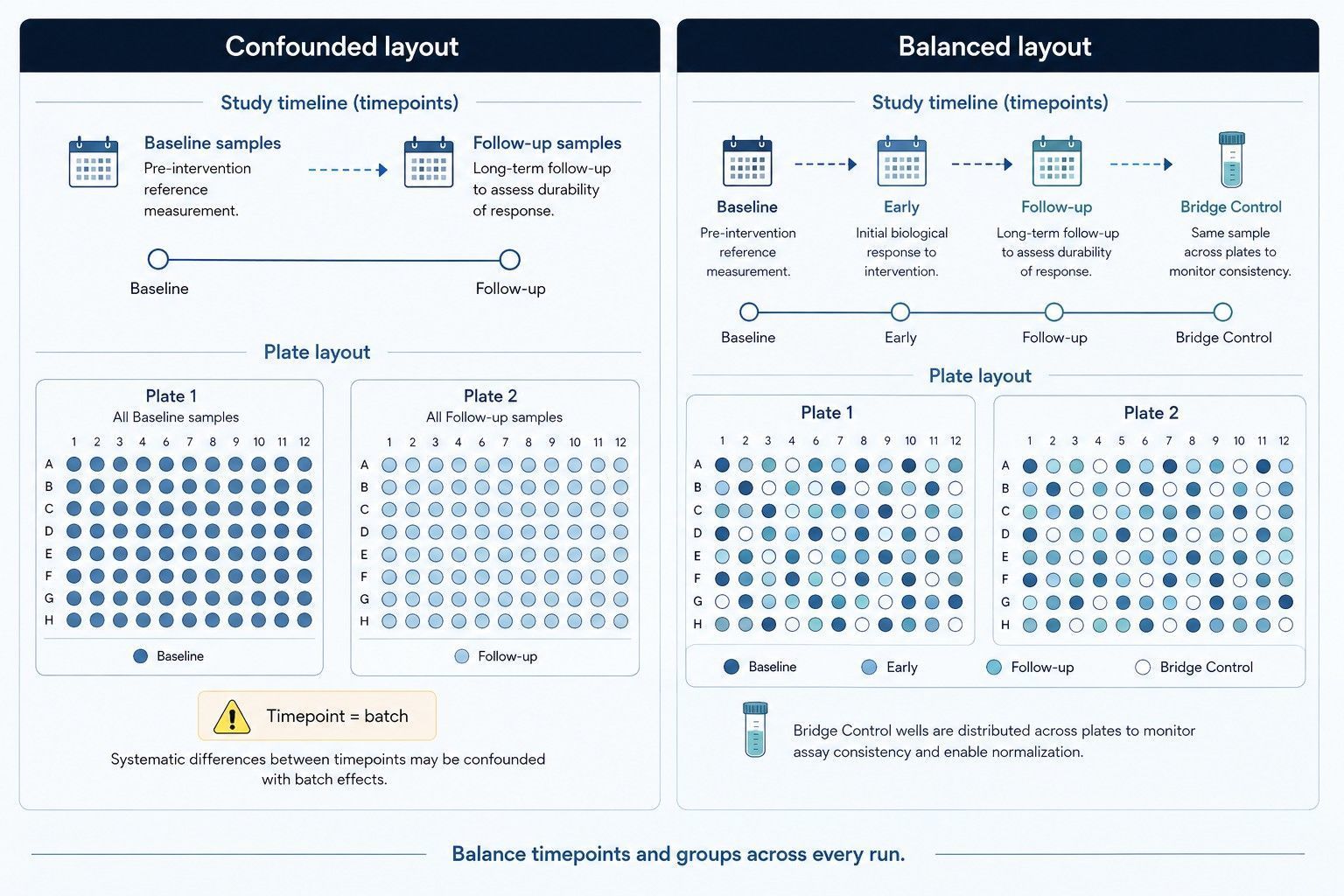 Balancing timepoints across plates keeps biological time separate from technical batch.
Controls and Quality Checks for Longitudinal Multiplex Cytokine Data
Use controls that answer a distinct question. A bridge material monitors repeatability across runs. Matrix-matched blanks monitor background. Assay standards and controls support analytical acceptance. Biological replicates characterize natural variability. None of these substitutes for the others.
Before comparing timepoints, inspect detection patterns, dilution behavior, duplicate agreement where available, and control trends by plate. Sample handling can affect absolute cytokine values; in one multiplex study, agreement between serum and plasma was poor for most cytokines and a thaw condition changed concentrations for many targets (Parkitny et al., 2013). The practical response is not to exclude difficult analytes automatically but to document the analytical context and decide in advance how relevant flags will be reported.
A useful longitudinal report includes a sample flow table, timepoint availability, analyte-level detection summary, plate and bridge-control summary, raw values with qualifiers, and the specified within-unit or group-level analysis. This gives researchers a way to separate a true absence of signal from a value outside the useful measurement range.
Analysis Planning for Repeated Cytokine Measurements
The analysis plan should respect the fact that repeated values from the same experimental unit are related. A baseline-to-follow-up comparison, a response trajectory, and a cross-sectional comparison at one timepoint are not interchangeable questions. State the primary contrast before the first plate is run: for example, change from baseline within unit, difference in change between groups, or difference at a prespecified follow-up interval.
Keep the timepoint variable in its original form as well as any derived visit label. Actual collection intervals may differ slightly from planned intervals, and the data record should allow that variation to be reviewed. If the study includes a control group, ensure that controls are collected, stored, and allocated to analytical batches on the same schedule as the comparison group.
A missing result can arise from a missed collection, insufficient volume, sample-quality limitation, or an analyte measurement outside the useful range. These situations should not be merged into one generic blank cell. Preserve the reason code and apply a prespecified approach to analysis and visualization. This is particularly important for longitudinal panels because dropout or missingness concentrated at one timepoint can change the apparent trajectory.
Common Longitudinal Cytokine Study Design Mistakes
- Choosing timepoints after observing a response in a pilot subset.
- Assigning all early and all late samples to separate analytical batches.
- Converting every analyte to fold change despite baseline values near the lower range.
- Dropping missing timepoints without retaining the reason and planned collection map.
- Treating a pooled control as a biological replicate.
- Combining serum, plasma, or different anticoagulant matrices in one direct longitudinal comparison without a matrix rationale.
Planning a Longitudinal Multiplex Cytokine Study
A project discussion should begin with the expected biological transition, the exact matrix, a draft collection calendar, experimental-unit count, paired-sample structure, available volume per timepoint, and the cytokines that make the study decision. It should also identify whether samples will arrive progressively or together, because that affects storage and batch design.
Creative Proteomics can support custom cytokine panel design and multiplex study planning with a timepoint map, batch-balancing strategy, relevant controls, and data-reporting rules. The aim is not simply to generate more longitudinal measurements; it is to make every reported change traceable to a defined biological interval and an auditable analytical context.
Longitudinal Cytokine Study Design Checklist
Before the first collection, freeze the primary question, timepoint definitions, collection windows, experimental-unit identifiers, matrix and tube rules, storage plan, planned plate map, bridge material, missing-sample policy, and primary change metric. Then use a small feasibility set only to refine analytical conditions that cannot be reliably predicted from the matrix and panel alone.
If the study needs a broad view of coordinated cytokine changes across repeated samples, use a balanced longitudinal multiplex design. If it needs a single end-state comparison, avoid adding timepoints that cannot be supported with consistent collection and batch allocation. The most useful design is the one whose time axis, technical layout, and reporting logic all answer the same research question.
Frequently Asked Questions
How many timepoints should a longitudinal cytokine study include?
Use the smallest set of timepoints that can distinguish baseline, expected response onset, and the later state relevant to the hypothesis. A small kinetic feasibility set is more informative than adding evenly spaced collections with no biological rationale.
Should samples from one donor be measured on the same plate?
Where feasible, keep paired samples from the same donor on the same plate or distribute them using a documented balanced design. The key requirement is that timepoint and study group are not confounded with analytical batch.
Can baseline cytokine values be used as each sample's own reference?
Yes, when a true baseline exists and the study question concerns within-sample change. Preserve the raw concentrations as well, because fold-change calculations become unstable when baseline measurements are near the lower reporting range.
What should be repeated across cytokine assay batches?
Repeat a matrix-relevant pooled control or bridge material, plus the same control logic and reporting rules, across every batch. This supports detection of technical drift without replacing biological replicates.
How should missed longitudinal timepoints be handled?
Record why a sample is absent and preserve the intended timepoint map. Do not replace a missing collection with a nearby timepoint unless the analysis plan explicitly allows that interpretation.
When should a time course use a mixed-effects model?
A mixed-effects approach is useful when repeated measurements from the same experimental unit are correlated and some collections are incomplete. The model should reflect the planned study design and be finalized before group differences are interpreted.
References:
- Brøndum L, et al. An evaluation of multiplex bead-based analysis of cytokines and soluble proteins in archived lithium heparin plasma, EDTA plasma and serum samples. Scandinavian Journal of Clinical and Laboratory Investigation. 2016;76:601–611.
- Parkitny L, et al. Multiplex cytokine concentration measurement: how much do the medium and handling matter? Mediators of Inflammation. 2013;2013:890706.
- Biancotto A, et al. Effect of anticoagulants on multiplexed measurement of cytokine/chemokines in healthy subjects. Cytokine. 2012;60:438–446.
- Rosenberg-Hasson Y, et al. Effects of serum and plasma matrices on multiplex immunoassays. Immunologic Research. 2014;58:224–233.
- Lee JW, et al. Fit-for-purpose method development and validation for successful biomarker measurement. Pharmaceutical Research. 2006;23:312–328.